

Safe Indoor Plants for Cat Owners: Pet-Friendly Picks

Last Updated: November 9, 2026
Quick Summary
Spider plant, Boston fern, parlor palm, peperomia, calathea and prayer plant are widely listed as safe indoor plants for cats. Always confirm the botanical name on the tag against the ASPCA Toxic and Non-Toxic Plants database before buying, since common names can mislead.
- Spider plant, Boston fern and parlor palm are among the most recognized cat-safe picks.
- Common names are unreliable; search the two-word Latin name in the ASPCA database.
- Asparagus fern is not safe and looks much like a Boston fern.
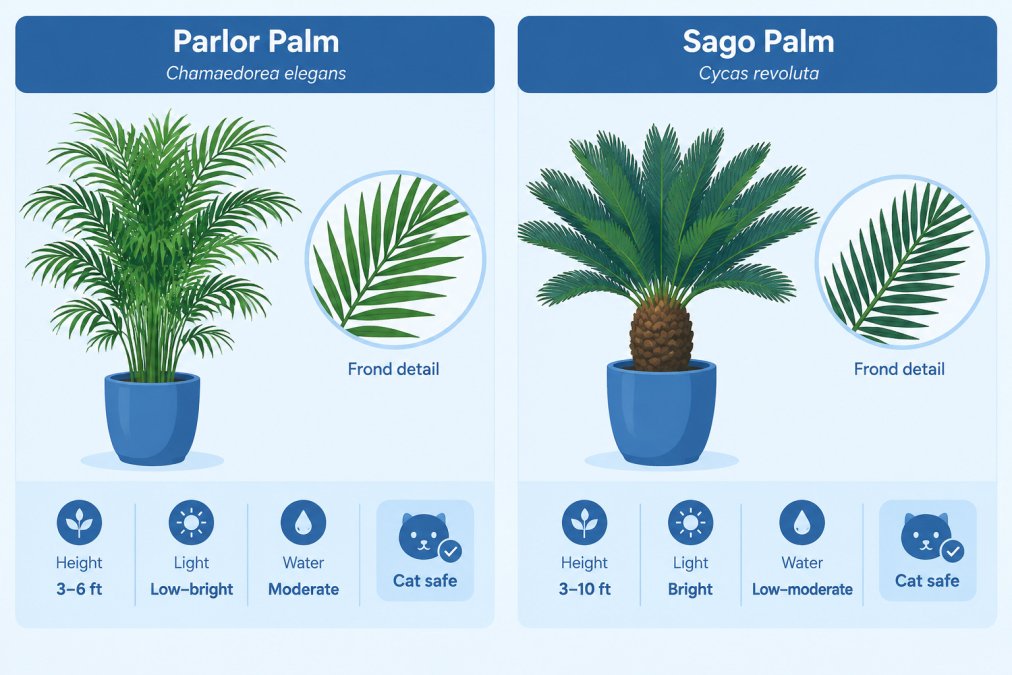
- Sago palm is dangerous and can be mistaken for parlor palm.
- Call a veterinarian right away for breathing trouble, repeated vomiting or tremors.
Table of Contents
- Why Plant Safety Matters When You Share Your Home With Cats
- Non-Toxic Indoor Plants That Are Safe for Cats
- ASPCA Toxic and Non-Toxic Plants List: How to Verify a Plant Before You Buy
- Care and Light Needs: Choosing Easy-Care Plants for a Busy Home
- How to Keep Cats Away From Houseplants Without Giving Up Greenery
- Signs of Plant Poisoning in Cats and What to Do Next
- Choosing Your First Cat-Safe Plants at Smitty's Pet Store
- Frequently Asked Questions
Why Plant Safety Matters When You Share Your Home With Cats
Safe indoor plants for cat owners are a smart choice because cats chew, paw and sometimes nibble on whatever sits within reach.
Cats are natural explorers. They climb shelves, knock things off tables and investigate anything that moves or smells interesting. A pot on a windowsill is an invitation.
The good news is that many popular houseplants are considered non-toxic to cats.
Non-Toxic Indoor Plants That Are Safe for Cats
Many of the most popular houseplants fall into a cat-friendly group. These plants are widely listed as non-toxic to cats, which makes them a practical starting point for shoppers who want greenery without worry.
The plants below are a good place to begin. Each one has its own light, water and size needs, so choose based on your home as well as your cat.
Spider Plant, Boston Fern and Parlor Palm
These three are among the most recognized cat-safe picks:
- Spider plant: Arching leaves and small plantlets make it fun to watch. It handles a range of light conditions and is very forgiving of missed waterings.
- Boston fern: Lush and full, it adds softness to a room. It prefers humidity and indirect light, so keep it away from harsh afternoon sun.
- Parlor palm: A slow grower that stays fairly compact, which suits smaller apartments. It thrives in medium to bright indirect light.
Many cat owners start with the spider plant because it is hardy. A hanging basket can keep it up and out of reach, which helps with curious cats.
Peperomia, Calathea and Prayer Plant
These plants add color and texture to a shelf or desk:
- Peperomia: Compact and available in many leaf patterns. It likes bright indirect light and needs water only when the top of the soil dries out.
- Calathea: Known for striking leaf patterns. It prefers humidity and filtered light, and it can be fussy about tap water, so check its care tag.
- Prayer plant: Its leaves fold up at night, which many people find charming. It needs moderate light and consistent moisture.
If you want a plant that looks good on a low table, peperomia is a strong choice. It stays small and is easy to keep in a bright spot.
ASPCA Toxic and Non-Toxic Plants List: How to Verify a Plant Before You Buy
Most plant-safety mistakes start at the store, not at home. A tag that says "palm" or "fern" tells you almost nothing, because those words cover dozens of species with very different toxicity profiles. Verification is a two-minute habit that prevents most problems. For more on checking ingredients and safety claims before you buy, see how to verify safe pet product ingredients.
Why botanical names are the only reliable search term
The ASPCA Animal Poison Control Center maintains a searchable Toxic and Non-Toxic Plants database that lists plants by scientific name, with separate notations for cats, dogs and horses (Toxic and Non-toxic Plant Search). Common names are unreliable in that database for three reasons:
- One name, many plants. "Parlor palm" is generally applied to Chamaedorea elegans, but retailers also use it for unrelated palms. "Fern" can mean a safe Boston fern (Nephrolepis exaltata) or a toxic asparagus fern (Asparagus densiflorus).
- One plant, many names. The same species may be sold as "friendship plant," "baby rubber plant" or "peperomia." Searching any one of those may return nothing.
- Cultivar names add noise. "Golden" or "variegata" on a tag describes leaf color, not species, and will not appear in toxicity listings.
A practical workflow:
- Photograph the plant tag, including the small print.
- Find the two-word Latin name (genus and species) on the tag or the grower's website.
- Search that exact binomial in the ASPCA database and read the cat entry specifically, a plant can be non-toxic to dogs and toxic to cats.
- If the tag has no botanical name, ask the seller in writing or skip the plant.
Watch out: a plant sold without a botanical name is not proof of safety, it is proof that no one has verified it.
Toxic lookalikes that fool cat owners
Several of the most common misidentifications involve plants that sit next to safe choices on the same shelf:
- True fern vs. asparagus fern. Boston ferns and maidenhairs are listed as non-toxic. Asparagus fern (Asparagus densiflorus) is not, and its fine, feathery foliage looks nearly identical at a glance. Asparagus fern also produces red berries that are more tempting than leaves.
- Parlor palm vs. sago palm. Parlor palm is a safe, compact understory palm. Sago palm (Cycas revoluta) is one of the most dangerous plants a cat can chew and is often sold in the same tropical section. Sago has stiff, glossy, dark-green fronds and a thick trunk; parlor palm has thin, matte, arching fronds and clustered stems.
- Peperomia vs. philodendron. Round-leaved peperomias resemble some juvenile philodendrons, which contain calcium oxalate crystals. Philodendron leaves tend to be more heart-shaped and vining; peperomia leaves are usually thicker, more succulent and arranged in rosettes.
When references disagree
Different sources occasionally classify the same plant differently, usually because they are describing different species under one common name or because a plant's sap causes mechanical irritation even when it is not systemically toxic. If two reputable references conflict, treat the plant as unverified and ask your veterinarian before bringing it home.
ASPCA Toxic and Non-Toxic Plants database
Care and Light Needs: Choosing Easy-Care Plants for a Busy Home
Cat-safe plants are only useful if they survive in your home. Choose plants that match your light, your schedule and your watering habits. A plant that needs daily attention will be hard to keep alive if you work long hours.
Look for these traits when shopping:
- Light: Check whether the plant wants bright indirect light, filtered light or lower light.
- Water: Plants like the spider plant tolerate occasional missed watering better than moisture-loving ferns.
- Size: Consider the mature size and spread so the plant fits the space.
A simple rule helps: pick one or two low-maintenance plants first, then add more as you learn their needs. Starting small keeps the process from feeling overwhelming.
How to Keep Cats Away From Houseplants Without Giving Up Greenery
Even cat-safe plants can cause stomach upset if your cat eats a lot of them. The goal is to keep plants out of reach while still enjoying them. Try these practical steps:
- Place plants on high shelves or in hanging planters.
- Use a sturdy plant stand that is hard to climb or tip over.
- Set up a cat grass pot as a safe alternative to nibble on. For practical ways to redirect cat behavior like scratching, read step-by-step guidance on stopping cat scratching.
A dedicated cat grass pot can give your cat something green to chew while the houseplants stay out of the way.
Signs of Plant Poisoning in Cats and What to Do Next
Plant exposures range from a mildly upset stomach to a true emergency, and the difference usually comes down to which plant was chewed and how much. For a broader guide to foods and substances that are dangerous for pets, see toxic foods for pets to avoid. Knowing the mechanism helps you describe the situation accurately when you call for help.
The three main ways plants harm cats
- Insoluble calcium oxalate crystals. Plants in the aroid family, philodendron, pothos, dieffenbachia, peace lily, calla lily, contain microscopic needle-shaped crystals. Chewing releases them into the mouth and throat, causing immediate pain, drooling, pawing at the mouth and swelling. Most exposures are painful but not life-threatening; severe swelling that affects breathing is an emergency.
- Soluble oxalates. Plants such as sago palm and some shamrocks contain oxalates that are absorbed into the bloodstream and can affect the kidneys. Signs may be delayed by hours, which is why a cat that seems fine right after chewing a sago palm still needs veterinary evaluation.
- Cardiac glycosides and other systemics. Oleander, foxglove and lily of the valley can cause heart rhythm disturbances. These are uncommon as houseplants but appear in cut-flower bouquets, which is one reason lilies and their vase water should never be within reach.
True lilies (Lilium and Hemerocallis species) deserve a separate warning: even small amounts of pollen, leaf or vase water can cause acute kidney injury in cats, and signs may not appear for 12 to 24 hours. A cat that brushed against a lily and then groomed itself should be evaluated.
Signs to watch for, by urgency
Call your veterinarian or a poison-control service immediately if you see:
- Difficulty breathing, open-mouth breathing or swelling around the muzzle
- Vomiting that repeats or contains blood
- Tremors, weakness, collapse or seizures
Monitor closely and call if signs persist beyond a few hours:
- Drooling, lip-smacking or pawing at the mouth
- One or two episodes of vomiting
- Mild diarrhea
Watch out: a cat that shows no signs in the first hour is not necessarily out of danger, delayed-onset plants like sago palm and true lilies can cause serious damage before symptoms appear.
What to have ready before you call
Veterinary teams and poison-control lines triage faster when you can provide four pieces of information:
- The plant's botanical name, or a clear photo of the leaf, stem and tag.
- The part chewed, leaves, stems, berries, roots or vase water.
- A rough quantity, estimated in leaves or bites rather than grams.
- The time of exposure and any signs you have observed since.
Bring the plant or a sealed sample in a labeled bag if you are heading to a clinic. Do not induce vomiting unless a veterinarian instructs you to; for some caustic plants, vomiting causes more damage on the way back up.
Aftercare and prevention
Once your cat is stable, review where the plant was kept and how the cat reached it. Most repeat exposures happen because a plant was moved to a "safe" shelf the cat could still reach from a counter or chair.
The table below summarises when to act, based on how urgent the signs are.
| Urgency | Signs | Action |
|---|---|---|
| Immediate | Difficulty breathing, open-mouth breathing or muzzle swelling | Call your veterinarian or a poison-control service immediately |
| Immediate | Repeated or bloody vomiting, tremors, weakness or seizures | Call your veterinarian or a poison-control service immediately |
| Immediate | Irregular heartbeat, pale gums or little or no urine | Call your veterinarian or a poison-control service immediately |
| Monitor and call | Drooling, lip-smacking or pawing at the mouth | Monitor closely; call if signs persist beyond a few hours |
| Monitor and call | One or two vomiting episodes, mild diarrhea | Monitor closely; call if signs persist beyond a few hours |
| Monitor and call | Reduced appetite or hiding | Monitor closely; call if signs persist beyond a few hours |
Choosing Your First Cat-Safe Plants at Smitty's Pet Store
Picking your first cat-safe plants is easier when you know your cat, your light and your schedule. Start with one or two hardy options, confirm each plant on a trusted list, and keep the rest out of reach.
Smitty's Pet Store offers a curated selection of pet supplies, ranging from everyday essentials and grooming products to playful accessories, along with practical tips to help you feel confident about your choices. For a complete checklist of what a new home with a cat needs, see essential supplies for first-time cat owners.
Frequently Asked Questions
What house plants are completely safe for cats?
No houseplant is guaranteed risk-free for every cat, because individual cats differ in how much they chew and how they react. That said, the ASPCA lists many common options as non-toxic to cats, including spider plants, Boston ferns, parlor palms, peperomias, Calatheas and prayer plants. Check the botanical name against the ASPCA database before buying, since sold names can vary by nursery. Even safe plants can cause mild stomach upset if a cat eats a large amount, so keep them out of reach and watch for changes in behavior after any chewing.
How can I tell if a plant is toxic to my cat?
Start by confirming the botanical name, not just the common name, because one common name can cover different species. Look up that botanical name in the ASPCA toxic and non-toxic plants list, which covers thousands of species and is free to search online. Lilies are a critical exception: even small amounts of true lilies and daylilies can cause kidney failure in cats, so avoid them entirely. If a plant is not listed, assume it is unknown and keep it away from your cat until you have verified it.
What should I do if my cat eats a houseplant?
Remove any remaining plant material from your cat's reach and note the plant's name or take a photo. Call your veterinarian or an animal poison control service for guidance. Do not induce vomiting unless a professional tells you to. Seek emergency care right away if your cat has trouble breathing, seizures, or severe lethargy, or if you suspect a lily was involved.
What are the best low-maintenance plants for cat owners?
Spider plants, parlor palms and cast iron plants are among the most forgiving choices for busy homes, since they tolerate irregular watering and a range of indoor light. Peperomias and string of hearts also handle short stretches without attention. Match each plant to the light in your home: bright indirect light suits most of these, while cast iron plants do well in lower light. Choose one or two plants to start so you can learn their watering rhythm before expanding.
