

Dog Behavior Modification vs Obedience Training

Table of Contents
- Dog Behavior Modification vs Obedience Training: Core Differences
- Understanding Dog Behavior Modification Techniques
- Obedience Training: Skills, Cues, and Commands
- Dog Reactivity Training: When Behavior Modification Takes Priority
- Positive Reinforcement Dog Training: The Foundation for Both Approaches
- Dog Trainer vs Behaviorist: Who Should You Work With
- How to Measure Progress and Realistic Timelines
- Building Your Training Plan: A Practical Decision Tree
- Frequently Asked Questions
Last Updated: October 18, 2026
Dog Behavior Modification vs Obedience Training: Core Differences
Understanding dog behavior modification vs obedience training is essential for addressing your dog's specific needs.
Dog behavior modification focuses on changing how your dog feels and reacts to specific triggers. It targets the emotional response and underlying cause of unwanted behaviors. Obedience training, by contrast, teaches your dog specific skills and commands through deliberate actions and operant conditioning.
The difference matters because they solve different problems. A dog who lunges at other dogs during walks has a reactivity issue, fear, frustration, or anxiety driving the behavior. Teaching "sit" won't fix that. A dog who doesn't respond to "come" needs obedience training.
What Each Approach Teaches
Obedience training teaches your dog to perform deliberate actions on cue. "Sit," "stay," "down," "come", these are specific skills triggered by your command or a prompt. Your dog learns that performing the action earns a reward.
Dog behavior modification teaches your dog to change his emotional response to a trigger. If your dog barks frantically when you leave the house (separation anxiety), behavior modification doesn't teach a new command. It gradually changes how your dog feels about your departure, reducing the anxiety that drives the behavior.
How They Address Root Causes
Obedience training assumes your dog understands what you want but hasn't learned the command yet. It works when the issue is a skill gap. Behavior modification addresses the root cause: the emotional state or learned association driving the behavior. A dog with genuine fear won't obey better commands, he needs his fear response reduced first.
This is why a fearful dog won't "obey away" his anxiety. Telling a terrified dog to "sit" and rewarding compliance doesn't change his fear.
Understanding Dog Behavior Modification Techniques
Dog behavior modification techniques reshape how your dog experiences and responds to specific triggers. These methods work on the emotional and learned associations driving behavior, not just the surface action.
Desensitization and Counterconditioning
Desensitization gradually exposes your dog to a trigger at levels low enough that he doesn't react.
Counterconditioning pairs the trigger with something positive, so your dog's emotional response changes. If your dog lunges at bicycles, counterconditioning means bicycles appear, then treats appear. Your dog learns: bicycle = good things happen.
These techniques work together. Desensitization keeps your dog calm enough to learn. Counterconditioning changes what the trigger means to him. A dog who was terrified of thunderstorms can gradually learn that storms predict treats and play, reducing anxiety over time.
Managing Triggers and Thresholds
Every dog has a threshold, the distance or intensity at which a trigger causes a reaction. A dog reactive to other dogs might remain calm if another dog is 50 feet away but react if he's 10 feet away.
Managing triggers means controlling your dog's exposure while you work on changing his response. If your dog is reactive on leash, you avoid high-traffic areas during training. You choose quiet times and less-populated routes.
Understanding your dog's specific triggers and threshold distance or intensity guides your training plan. A dog afraid of loud noises needs a different approach than a dog frustrated by movement.
Obedience Training: Skills, Cues, and Commands
Obedience training teaches your dog to perform specific actions on cue. These are deliberate behaviors your dog learns to offer in response to a prompt or command. Unlike behavior modification, which changes emotional responses, obedience training focuses on building a repertoire of skills.
Deliberate Actions and Operant Conditioning
Operant conditioning is the learning principle behind obedience training. Your dog performs an action (sit), and a reward follows (treat, praise, play). Over repetitions, your dog learns the association: this action, in this context, with this cue, produces a reward.
The four components of operant conditioning are reinforcement (reward increases behavior), punishment (consequence decreases behavior), positive reinforcement (adding something desirable), and negative reinforcement (removing something undesirable).
Obedience training builds specific skills: sit, down, stay, leave it, come. Each is a deliberate action your dog learns to perform on your cue. These skills are tools.
Dog Reactivity Training: When Behavior Modification Takes Priority
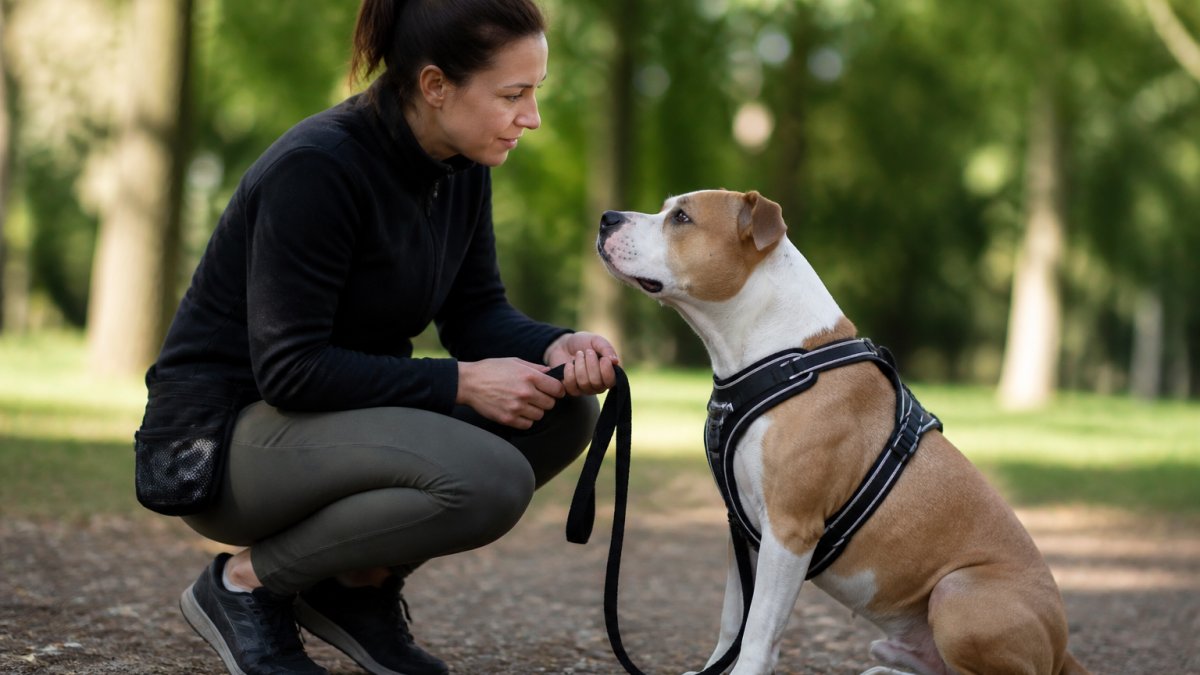
Dog reactivity, lunging, barking, or aggressive displays toward other dogs, people, or stimuli, is a behavior problem driven by an emotional state. Reactivity training is behavior modification, not obedience training, because the goal is changing your dog's emotional response to the trigger, not teaching a new command.
Identifying Reactivity, Fear, and Anxiety
Reactivity is an over-the-top response to a trigger. Your dog sees another dog and explodes into barking, lunging, or snarling. This isn't disobedience, your dog isn't ignoring your commands. His emotional state is so heightened that commands don't register or don't override the reaction.
Fear drives reactivity in dogs who perceive a threat. A dog lunging at strangers may be terrified, not aggressive.
These emotional states require behavior modification to address. Teaching a fearful dog to "sit" doesn't reduce his fear. Teaching an anxious dog a new command doesn't calm his anxiety.
Positive Reinforcement Dog Training: The Foundation for Both Approaches
Both obedience training and behavior modification rely on positive reinforcement as the most effective and humane method.
In obedience training, positive reinforcement rewards correct responses to commands. Your dog sits, you reward. Over time, he associates "sit" with reward and becomes more likely to sit on cue.
Remote Control Dog Training Device Dog Collar →
In behavior modification, positive reinforcement pairs the trigger with rewards, so your dog's emotional response shifts. Your dog sees another dog and gets treats.
Positive reinforcement works because it's based on what your dog wants. It's faster than punishment-based methods, creates stronger learning, and doesn't cause the fear or anxiety that punishment can introduce.
Dog Trainer vs Behaviorist: Who Should You Work With
Choosing between a dog trainer and a behaviorist depends on your dog's specific issue. Both can help, but they approach problems differently.
A dog trainer typically specializes in obedience training and basic behavior management. Trainers teach commands, leash manners, and basic skills.
A behaviorist (especially a certified animal behaviorist or veterinary behaviorist) specializes in complex behavior problems driven by fear, anxiety, or aggression. Behaviorists conduct detailed assessments, identify underlying causes, and design comprehensive modification plans.
The distinction matters. If your dog doesn't know "sit," hire a trainer. If your dog is terrified of thunderstorms or reactive to other dogs, a behaviorist's expertise is more relevant.
When to Seek a Veterinary Behaviorist
A veterinary behaviorist is a veterinarian with specialized training in behavior. This professional is essential when behavior problems have a medical component or when medication might help.
Anxiety disorders, aggression, and some compulsive behaviors can have underlying medical causes or benefit from anti-anxiety medication. A veterinary behaviorist can rule out medical issues, prescribe medication if appropriate, and design a behavior modification plan that works alongside medical treatment.
If your dog's reactivity or anxiety is severe, or if basic behavior modification isn't making progress, a veterinary behaviorist can assess whether medication would help.
How to Measure Progress and Realistic Timelines
Progress in behavior modification isn't always linear. Your dog might improve dramatically, then have a setback. Understanding what to measure and realistic timeframes helps you stay on track.
Tracking Frequency, Intensity, and Recovery Time
Measure three metrics to track your dog's progress:
-
Frequency: How often does the behavior occur? If your dog barks at other dogs 10 times during a walk now, and 5 times next month, frequency is improving.
-
Intensity: How severe is the reaction? Does your dog lunge and bark aggressively, or does he bark once and look back at you? Intensity often decreases before frequency does.
-
Recovery time: How long does it take your dog to calm down after a trigger? A dog who recovers in 30 seconds is making progress compared to one who's still aroused five minutes later.
Realistic progress in behavior modification typically takes weeks to months, depending on severity and consistency of training. A dog with mild leash reactivity might show improvement in 4-6 weeks. A dog with severe fear or aggression may need 3-6 months or longer. Setbacks are normal, a stressful event, a bad encounter, or inconsistent management can temporarily worsen behavior.
Obedience training often shows faster results. Most dogs learn basic commands in 2-4 weeks of consistent training. However, a dog with underlying anxiety won't reliably obey those commands in high-stress situations until his emotional state improves through behavior modification.
Building Your Training Plan: A Practical Decision Tree
Choosing between obedience training and behavior modification starts with identifying your dog's specific issue. Use these observable signs to guide your decision.
Observable Signs That Guide Your Choice
| Observable Sign | Likely Issue | Recommended Approach |
|---|---|---|
| Dog doesn't respond to commands (sit, stay, come) | Skill gap | Obedience training |
| Dog knows commands but doesn't obey in specific situations (on walks, around triggers) | Emotional response or reactivity | Behavior modification |
| Dog lunges, barks, or shows aggression toward specific triggers | Reactivity, fear, or frustration | Behavior modification |
| Dog panics when left alone, destroys things, eliminates indoors | Separation anxiety | Behavior modification + veterinary assessment |
| Dog pulls on leash but responds to commands in calm settings | Combination of skill gap and excitement | Obedience + management tools |
| Dog shows extreme fear (freezing, trembling, hiding) | Fear or anxiety disorder | Behavior modification + veterinary behaviorist |
Start by answering: Does your dog know what you're asking, but struggle to comply in specific situations? If yes, behavior modification. Does your dog not know the command at all? If yes, obedience training.
Equipment matters too. The No-Pull Reflective Dog Harness ($34.64) features front and back leash attachment points that redirect pulling naturally without choking. For escape artists or dogs needing extra security, the Escape-Proof Pet Harness & Leash ($38.73) includes a matching leash and snug chest design.


For basic obedience work, the Adjustable Pet Harness ($43.60) fits dogs from 4 kg to 70 kg and includes fully adjustable chest straps for a custom fit. These tools support your training plan by giving you better control and communication with your dog during sessions.

Frequently Asked Questions
What is the main difference between dog behavior modification and obedience training?
Obedience training teaches specific cued skills like sit, stay, and come through deliberate actions and operant conditioning. Behavior modification addresses emotional responses and underlying causes of problem behaviors like reactivity, fear, and anxiety. Obedience training focuses on what your dog does on command; behavior modification focuses on how your dog feels and reacts to triggers. Both use positive reinforcement, but they target different aspects of your dog's behavior.
When does a dog need behavior modification instead of obedience training?
Your dog needs behavior modification when showing emotional or reactive problems such as fear-based aggression, separation anxiety, leash reactivity, or excessive barking triggered by specific situations. These issues stem from underlying emotional responses, not lack of training. Obedience training alone won't resolve them because the root issue is the dog's emotional state, not disobedience. A veterinary behaviorist can assess whether medication or desensitization techniques are necessary alongside management strategies.
What are common dog behavior modification techniques?
Common techniques include desensitization (gradually exposing your dog to a trigger at lower intensity), counterconditioning (changing your dog's emotional response to a trigger), and threshold management (keeping your dog below the reactivity threshold during training). These methods work by addressing the learned behavior and emotional response, not just teaching a command. Progress depends on consistency from the handler and realistic timelines; most dogs show measurable improvement in frequency and intensity of reactions within 4-8 weeks of structured behavior modification.
What's the difference between a dog trainer and a behaviorist?
A dog trainer typically teaches obedience skills and basic manners using cues and commands. A behaviorist (especially a certified or veterinary behaviorist) diagnoses and treats behavior problems rooted in fear, anxiety, or learned responses. Trainers focus on deliberate actions; behaviorists focus on emotional and behavioral change. For reactivity, aggression, or anxiety, a behaviorist's assessment is more appropriate. A veterinary behaviorist can also evaluate whether medication or medical conditions contribute to problem behavior.
Your dog's behavior problem likely involves both skill gaps and emotional responses. The most effective approach combines obedience training to build reliable commands with behavior modification to address the underlying triggers and emotional states driving unwanted behavior. Start by identifying which issue is primary, then choose your professional guidance accordingly. With consistency and the right tools, most dogs make meaningful progress within weeks to months.