

Positive Reinforcement vs Punishment for Dogs

Table of Contents
- Understanding Positive Reinforcement vs Punishment for Dogs
- Positive Reinforcement Dog Training Methods
- Reward-Based Dog Training Examples
- Best Treats for Dog Training
- How to Stop Unwanted Dog Behavior
- Punishment Methods and Their Risks
- Comparing Effectiveness and Long-Term Results
- Frequently Asked Questions
Last Updated: October 14, 2026
Understanding Positive Reinforcement vs Punishment for Dogs
When your dog pulls on the leash, jumps on guests, or ignores commands, you face a choice: reward the behavior you want, or correct the behavior you don't.
Positive reinforcement is adding something desirable, a treat, praise, or play, immediately after a behavior, making it more likely to recur. Punishment removes something desirable or adds something unpleasant to decrease a behavior.
Understanding how each approach works, where it succeeds, and where it fails will help you choose the right strategy for your dog's specific behavior problem.
The Four Learning Quadrants
Dog learning operates within four quadrants that explain how consequences shape behavior.
Positive reinforcement (adding something good) increases a behavior.
Positive punishment (adding something unpleasant) decreases a behavior.
The naming convention trips up most people. "Positive" and "negative" don't mean good and bad. They mean adding or removing. A "positive" punishment still decreases behavior; it's just achieved by adding an aversive stimulus rather than removing a reward.
How Each Approach Changes Behavior
Positive reinforcement works by creating association.
Punishment teaches avoidance: "When I do X, something bad happens, so I'll stop." The behavior decreases, but the dog's motivation is fear or discomfort, not understanding.
The critical difference emerges over time. Reinforcement-trained behaviors tend to be consistent across contexts because the dog understands the rule.
Timing matters intensely in both approaches. Reinforcement delivered within 1-2 seconds of the behavior creates a clear association.
Positive Reinforcement Dog Training Methods
Positive reinforcement training builds desired behaviors through consistent reward. The method is straightforward in principle but requires precision in execution.
Start with a clear target behavior. Don't aim for "good behavior" generally. Define exactly what you want: sit on command, walk without pulling, make eye contact, lie down on a mat.
Identify a reward that motivates your dog. For some dogs, a high-value treat works best. For others, play or praise carries more weight.
Timing and Consistency Matter
The moment you reward matters more than the reward itself. Deliver the reward within one to two seconds of the desired behavior.
Consistency is equally critical. Every time your dog performs the target behavior in early training, reward it.
Many owners inadvertently punish good behavior by being inconsistent. One day you reward your dog for sitting before going outside; the next day you're in a rush and don't. Your dog learns that sitting is unreliable, and motivation drops.
Building the Association
Your dog doesn't understand language the way you do. They learn through association and prediction.
Start in low-distraction environments. Your living room is easier than a busy park. Once the behavior is solid at home, practice in gradually more distracting settings.
Use a marker word, a sound that signals "that exact behavior earned the reward." A clicker works perfectly. Click the moment your dog sits, then deliver the treat.
Reward-Based Dog Training Examples
Reward-based training works across nearly every behavior problem. The approach changes based on what you're trying to teach.
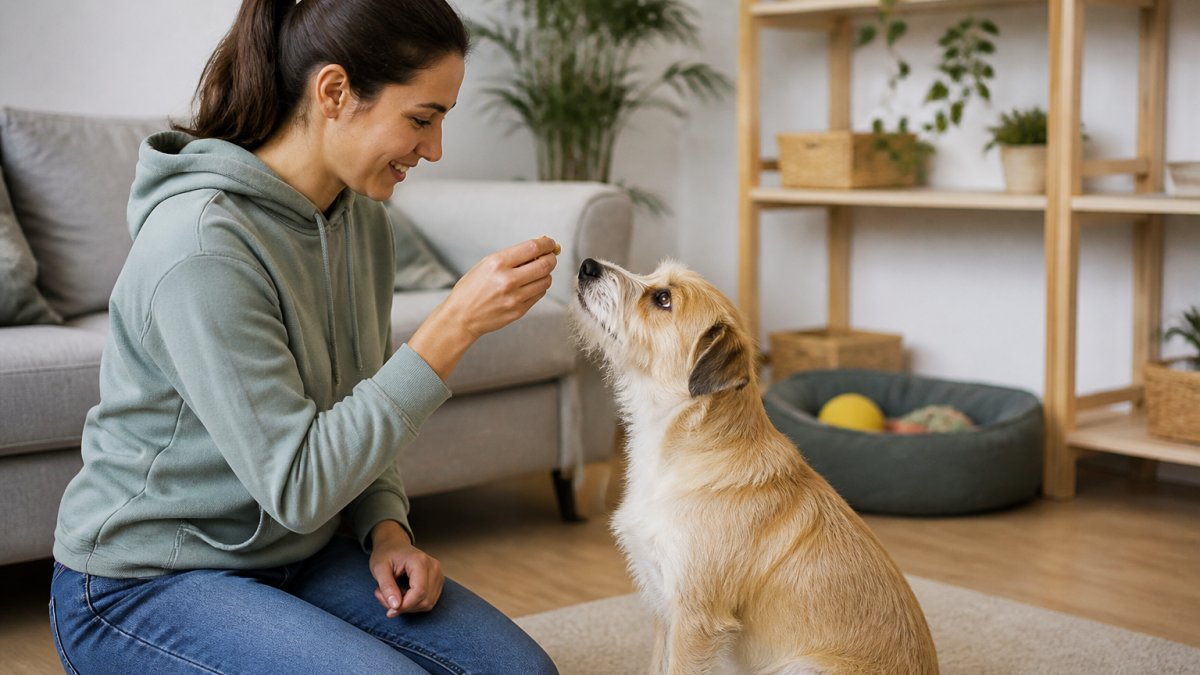
For loose-leash walking, reward your dog for walking beside you without tension on the leash.
For recall (coming when called), start in a confined space and reward heavily every time your dog comes to you.
For jumping on guests, reward your dog for sitting instead. When someone arrives, ask your dog to sit before they enter. Reward the sitting.
Common Training Scenarios
Housebreaking relies on reinforcement and management. Take your dog outside frequently, and reward heavily every time they eliminate outside. Indoors, prevent accidents by supervising closely and restricting access.
Reducing reactivity to other dogs or people starts with rewarding calm behavior near the trigger.
Separation anxiety improves through gradual desensitization paired with rewards for calm behavior alone. Start by rewarding your dog for being calm while you're in the room but not interacting.
Best Treats for Dog Training
Not all treats work equally in training. The best treats for dog training are high-value, small, and fast to consume.
High-value means your dog actively wants it. Kibble from their regular meal won't motivate as strongly as something tastier.
Size matters because training involves many repetitions. A treat the size of a pea delivers the reward without filling your dog's stomach.
Speed of consumption is critical. A treat your dog spends 10 seconds chewing breaks the association between behavior and reward.
Treat Selection and Motivation
Rotate treats to prevent habituation. Your dog's enthusiasm for the same treat diminishes over time. By varying between chicken, cheese, and commercial training treats, you maintain motivation. Some trainers reserve the absolute highest-value treat, perhaps freeze-dried liver, for the hardest behaviors or most distracting environments.
Consider your dog's individual preferences. Some dogs are food-motivated; others care more about play or praise. If your dog shows little interest in treats, try play-based rewards.
At Smitty's Pet Store, we offer several options designed specifically for training. The Brain Games Treats Birthday Squeaky Pet Toys ($26.01) combines treat dispensing with enrichment, letting you hide small training treats inside for puzzle-based learning. The Pet Toys Acorn Shape Feeding Toy Ball ($28.85) dispenses treats as your dog rolls and nudges it, reinforcing activity and problem-solving during play.


How to Stop Unwanted Dog Behavior
Stopping an unwanted behavior requires identifying what reinforces it, then removing that reinforcement or replacing it with a desired alternative.
Most unwanted behaviors persist because they work for the dog. Jumping works because it gets attention, even scolding is attention. Barking works because it makes something happen: a door opens, you come running, other dogs respond. Pulling on the leash works because the dog reaches their destination faster. Before you can change these behaviors, you must understand their function.
Remote Control Dog Training Device Dog Collar →
Replacing Punishment with Reinforcement
The alternative to punishment isn't ignoring the behavior. It's reinforcing a different behavior that's incompatible with the unwanted one.
Your dog can't jump on you while sitting. They can't pull on the leash while walking at your side. They can't bark at the mailman while focused on you.
If your dog jumps on guests, teach sit. Practice until it's rock-solid. When guests arrive, ask your dog to sit before they enter. Reward sitting.
For self-reinforcing behaviors like chewing, digging, or sniffing, management becomes critical. Provide an interactive toy like the Pet Dog Sniff & Snack Puzzle Ball ($26.89) to channel the sniffing instinct into an acceptable activity.

Safety and When to Seek Professional Help
Some behaviors require professional intervention. Aggression toward people or other animals, severe anxiety, or behaviors that pose safety risks need a certified professional trainer or veterinary behaviorist.
If your dog has bitten or shown serious aggression, do not attempt to train this alone.
Separation anxiety that results in self-injury, destructive behavior, or escape attempts also warrants professional help.
If your current training approach isn't working after consistent effort over several weeks, seek professional guidance.
Punishment Methods and Their Risks
Punishment-based training uses aversive stimuli to decrease unwanted behavior. The methods range from mild to severe, and the risks increase with intensity.
Common aversive stimuli include verbal corrections ("no," "ah-ah"), leash jerks, spray bottles, shock collars, prong collars, and choke chains. Each carries a different level of risk and produces different outcomes.
Types of Aversive Stimuli
Verbal corrections are mild aversive stimuli.
Leash jerks apply physical discomfort through the collar. The intensity depends on the force and the collar type.
Spray bottles deliver a sudden spray of water, which startles and mildly irritates. This is a low-intensity aversive stimulus.
Shock collars deliver electrical stimulation triggered by remote control or automatically when the dog barks.
Prong collars and choke chains apply pressure to the neck when the dog pulls. The discomfort increases as the dog pulls harder.
Behavioral and Welfare Outcomes
Research and practical experience show that punishment-based methods produce several consistent outcomes. Behavior suppression is immediate and often dramatic.
However, suppression differs from learning. A dog trained with punishment learns to avoid the behavior in situations where punishment is likely, not to understand an alternative behavior.
Stress and anxiety often accompany punishment-based training. Dogs trained with aversive methods show elevated cortisol levels, increased vigilance, and signs of anxiety (Does training method matter? Evidence for the negative impact of aversive-based methods...).
Aggression is a documented risk of punishment-based training, particularly with aversive stimuli applied to the face or neck.
Learned helplessness can develop in dogs subjected to inescapable punishment (Learned Helplessness at Fifty: Insights from Neuroscience).
Comparing Effectiveness and Long-Term Results
When comparing positive reinforcement vs punishment for dogs, effectiveness depends on the timeframe and the outcome you're measuring.
In the short term, punishment often appears more effective. A dog corrected sharply for jumping may stop jumping within days.
Over months and years, the picture changes. Dogs trained with positive reinforcement show consistent behavior across contexts, sustained motivation, and stable emotional states. Dogs trained with punishment show context-dependent behavior, diminishing motivation, and increased anxiety or aggression.
Training Speed and Sustainability
Positive reinforcement training is slower initially because you're teaching a replacement behavior, not just suppressing an unwanted one. Your dog learns: "Sitting produces attention," not just "Jumping produces nothing." This learning takes repetition and consistency.
Once learned, reward-based behaviors are sustainable. Your dog continues the behavior because the reward remains consistent. A dog trained to sit for attention will sit for attention for years if you continue rewarding it.
Punishment-based behavior suppression is initially fast but often deteriorates over time.
Individual Differences and Age Considerations
Age affects how dogs respond to both approaches. Puppies are learning rapidly and are sensitive to both rewards and corrections.
Senior dogs often respond better to gentler approaches. Older dogs may have hearing loss, reduced pain tolerance, or existing anxiety.
Temperament matters significantly. Confident, resilient dogs may tolerate punishment-based training with fewer negative side effects than sensitive, anxious dogs.
Breed predispositions also play a role.
| Comparison Factor | Positive Reinforcement | Punishment |
|---|---|---|
| Initial Speed | Slower (weeks to months) | Faster (days to weeks) |
| Long-Term Sustainability | Stable and consistent | Often deteriorates over time |
| Context Generalization | Transfers across environments | Often context-dependent |
| Dog's Emotional State | Confident, engaged, eager | May be anxious, fearful, or shut down |
| Motivation | Intrinsic (dog understands the behavior works) | Extrinsic (dog avoids punishment) |
| Risk of Side Effects | Low | Moderate to high (anxiety, aggression, learned helplessness) |
| Best For | Most dogs, all ages, long-term behavior | Specific behaviors, short-term suppression only |
The choice between positive reinforcement vs punishment for dogs isn't simply a matter of preference or philosophy. The Brain Games Treats toy and Sniff & Snack Puzzle Ball make reward-based training engaging and effective.
Frequently Asked Questions
What is the difference between positive reinforcement and punishment in dog training?
Positive reinforcement adds something desirable (a treat, praise, or play) after a desired behavior occurs, making the dog more likely to repeat it. Punishment removes something pleasant or adds something unpleasant after unwanted behavior, aiming to decrease it. Positive reinforcement strengthens desired behaviors, while punishment attempts to suppress unwanted ones. The key difference is what happens after the behavior and the dog's emotional response.
Is positive reinforcement more effective than punishment for dogs?
Research and professional trainers widely support positive reinforcement as more effective for lasting behavior change. Punishment can suppress behavior temporarily but often creates anxiety, aggression, or avoidance of the handler.
What are examples of positive reinforcement in dog training?
Common examples include giving a treat immediately after your dog sits on command, praising enthusiastically when they come when called, or allowing play time after they walk calmly on leash. Interactive toys like the Brain Games Treat toy ($26.01) or Pet Toys Acorn Shape Feeding Toy Ball ($28.85) also deliver treats as rewards, reinforcing desired behaviors. The key is timing: the reward must come within seconds of the correct behavior so your dog makes the association.
How do you stop unwanted dog behavior without punishment?
Replace the unwanted behavior with a desired one and reward that instead. For example, if your dog jumps on guests, teach them to sit instead and reward sitting when guests arrive. Redirect energy through enrichment toys and exercise to prevent boredom-driven misbehavior. Remove triggers when possible, stay consistent, and reward calm behavior frequently. If aggression, fear, or severe behavioral issues arise, consult a certified professional trainer or veterinary behaviorist for guidance.
What are the best treats for dog training?
The best training treats are small, soft, and high-value (something your dog loves). They should be easy to eat quickly so training stays efficient and your dog stays focused. Treats work best when paired with praise and play for variety. Interactive toys like the Pet Dog Sniff & Snack Puzzle Ball ($26.89) combine treat rewards with mental enrichment, keeping training sessions engaging and preventing treat fatigue during longer sessions.