

Pet Food Cost Comparison by Brand 2026: What to Expect

Table of Contents
- Pet Food Cost Comparison by Brand: What Changed in 2026
- Cost Per Serving Pet Food Calculator: A Simple Way to Compare
- Budget vs. Premium: Breaking Down the Price Gap
- Wet vs. Dry Food: Cost Per Calorie, Not Cost Per Pound
- How to Save Money on Pet Food Without Sacrificing Quality
- Best Affordable Dog Food 2026: Our Top Picks
- Feeding Tools That Keep Costs Down
- Final Thoughts on Pet Food Cost Comparison by Brand
- Frequently Asked Questions
Last Updated: September 6, 2026
Pet Food Cost Comparison by Brand: What Changed in 2026
A pet food cost comparison by brand in 2026 reveals a wider spread between budget and premium tiers than most owners expect. Producer price index data shows steady increases in the cost of raw ingredients like meat meal and poultry fat (bls.gov).
Feeding your pet is often the largest recurring expense you will manage. Below, we'll show you how to compare options using cost per serving rather than sticker price.
The most important shift: the gap between a $1.50-per-pound economy kibble and a $4.00-per-pound premium formula has widened, but the cost-per-day difference is often smaller than you think.
Cost Per Serving Pet Food Calculator: A Simple Way to Compare
A cost per serving pet food calculator is the only fair way to compare brands that sell in different bag sizes and with different feeding guidelines. Divide the price per bag by the number of servings the bag actually delivers, based on your pet's weight and the manufacturer's recommended daily portion.
Here is the three-step method we use:
- Find the feeding guidelines on the bag for your pet's current weight.
- Divide the bag weight by the daily portion to get the number of days it lasts.
- Divide the bag price by that number of days to get your true cost per day.
The result changes decisions. A $60 bag of calorie-dense premium food might last 35 days for a 40-pound dog, while a $40 economy bag lasts only 25 days because the feeding guideline requires a larger portion. The premium brand wins on cost per day at $1.71 versus $1.60.
Budget vs. Premium: Breaking Down the Price Gap
The price gap between budget and premium pet food comes down to three controllable factors: ingredient sourcing, manufacturing standards, and quality assurance testing. Budget brands use commodity ingredients purchased on the open market; premium brands lock in contracts with specific farms and suppliers, stabilizing their costs but keeping shelf prices higher.
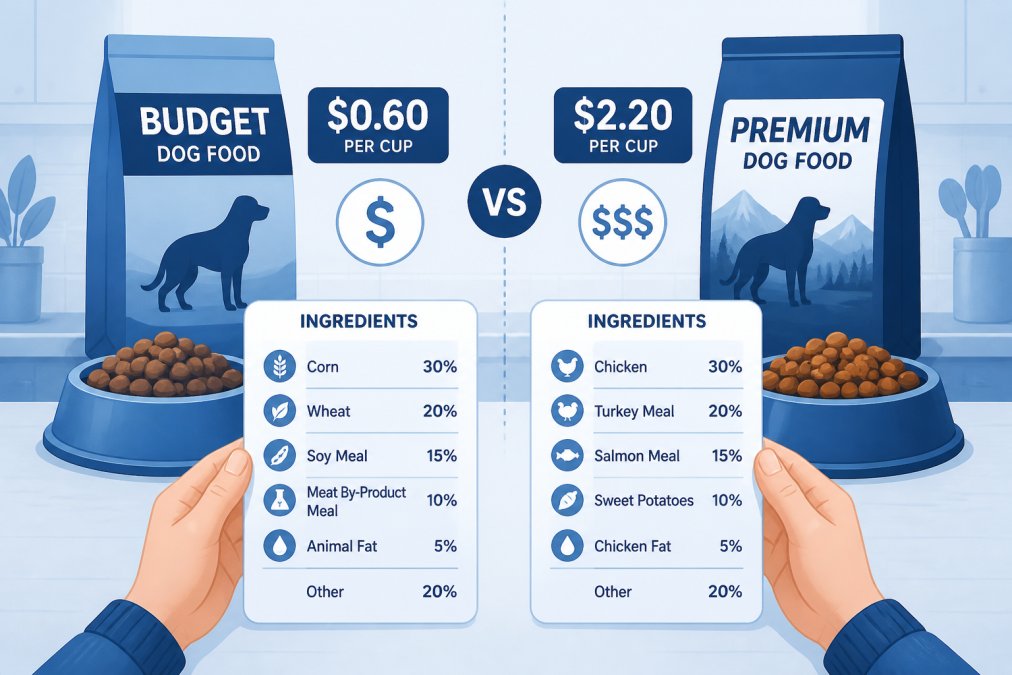
What You Pay For in a Premium Bag
Premium pricing reflects concrete costs budget brands often skip: third-party testing for contaminants and nutritional adequacy, higher-quality fat sources and named meat meals, and smaller-batch production runs.
None of this means budget food is automatically bad. Many economy brands meet AAFCO nutritional adequacy standards and can be reasonable for healthy adult pets. What you pay for in a premium bag is consistency, traceability, and often better digestibility.
Wet vs. Dry Food: Cost Per Calorie, Not Cost Per Pound
Comparing wet and dry food by weight is a trap. Canned food is mostly water, sometimes 75 percent or more, making it look dramatically overpriced per pound (the FDA). The fair metric is cost per calorie.
Kibble delivers 350 to 450 calories per cup; canned food delivers 150 to 250 per can. Tracking cost per calorie shows wet food running two to four times higher than dry. For a 30-pound dog needing roughly 800 calories daily, wet food costs $4 to $6 per day, while premium kibble runs $1.50 to $2.50.
The Cost-Per-Calorie Math That Changes Decisions
Most price comparisons go wrong by comparing a 5-pound bag of kibble to a 13-ounce can. Instead, standardize by the calories your pet actually needs:
- Find the kcal per cup or per can on the label (AAFCO requires this information).
- Divide the price per bag or case by the total kcal it contains.
- Multiply by your pet's daily kcal requirement to get a true cost per day.
A concrete example: A $60 bag of premium kibble containing 4,000 kcal costs $0.015 per kcal. A $30 case of 12 cans, each containing 200 kcal, delivers 2,400 kcal total, costing $0.0125 per kcal. The canned food is actually cheaper per calorie than the premium kibble.
When Wet Food Justifies the Premium
The role of wet food changes when you account for its benefits. Higher moisture content supports urinary tract health, and many pets find it more palatable, helping picky eaters and seniors with dental issues. The practical approach for most owners is a mixed strategy: dry food as the base, with wet food as a topper.
For cats, the calculus shifts further. Feline urinary tract issues are among the most common reasons for veterinary visits, and increasing water intake through canned food is a well-established preventive measure. A $0.05-per-kcal difference may be worth it if it prevents a $500 vet bill.
The Mixed-Feeding Strategy That Balances Cost and Health
Most veterinary nutritionists recommend a combination approach for owners who want wet food benefits without the full cost. A common pattern is feeding dry kibble as the base and adding a spoonful of wet food as a topper.
For a 30-pound dog needing 800 kcal daily, a mixed strategy using premium kibble at $0.015 per kcal and wet topper at $0.03 per kcal (20 percent of daily calories from wet) yields a daily cost of roughly $2.10, only $0.60 more than all-dry feeding.
How to Save Money on Pet Food Without Sacrificing Quality
Saving money on pet food is about reducing waste and buying smarter, not trading down to lower-quality formulas. The biggest hidden cost in most households is overfeeding.
Portion Control and Waste Reduction
Most owners pour by eye, resulting in portions 20 to 30 percent larger than feeding guidelines recommend. Over a year, that overfeeding can waste several full bags of food.
A programmable automatic feeder removes the guesswork entirely. Set the portion once and the feeder dispenses the exact amount at the scheduled time. The Smitty's Pet Store Automatic Pet Feeder with Timer & Stainless Steel Bowl costs $46.65 and pays for itself quickly if it prevents even a single wasted bag.

Another overlooked source of waste is stale food. Kibble that sits open loses palatability and nutritional value, and many pets refuse to finish it. Airtight Food Storage Slots at $80.90 keeps multiple food types fresh and organized.

Subscription vs. Retail: The Long-Term Savings Model Most Owners Miss
Most pet food comparisons treat every purchase as a one-time retail transaction. But in 2026, the subscription model has fundamentally changed the cost equation. Auto-ship programs routinely offer 10 to 20 percent off retail, plus free shipping.
Here is the math that matters: A $60 bag of premium kibble purchased monthly at retail costs $720 per year. The same bag on a subscription at 15 percent off costs $612 annually, a savings of $108.
But subscription savings are not automatic. Auto-ship programs lock you into a schedule that may not match your pet's actual consumption rate. Calculate your pet's exact daily portion first, then set the subscription interval to match.
Life-Stage Cost Forecasting: Planning for the Full Pet Lifespan
A comparison that only looks at the current moment misses the biggest cost driver: your pet's changing nutritional needs over time. Puppies and kittens require calorie-dense growth formulas costing 20 to 30 percent more per pound than adult maintenance diets. Senior pets often need joint supplements and lower-calorie formulas.
A realistic cost forecast for a medium-breed dog looks like this:
| Life Stage | Duration | Daily Calorie Need | Cost per Day (Mid-Tier) | Annual Cost |
|---|---|---|---|---|
| Puppy (growth formula) | 12 months | 1,200 kcal | $2.50 - $3.00 | $910 - $1,095 |
| Adult (maintenance) | 8 years | 800 kcal | $1.50 - $2.25 | $550 - $820 |
| Senior (joint support) | 4 years | 700 kcal | $2.00 - $2.75 | $730 - $1,000 |
The lifetime cost for that dog runs between $6,500 and $8,500, depending on brand tier and portion management. The difference between the low and high end is not just brand choice, it is portion control and avoiding waste.
Best Affordable Dog Food 2026: Our Top Picks
For 2026, the best affordable dog food options balance nutritional adequacy, ingredient quality, and cost per day. The clear winners are value-tier brands from major manufacturers with their own quality assurance programs.
For most owners, a mid-tier kibble from a manufacturer with dedicated veterinary nutritionists on staff can be a good choice. These brands often run $2.00 to $2.75 per pound and deliver a cost per day of $1.50 to $2.25 for a 40-pound dog. They typically use named meat meals and back formulas with feeding trials.
The table below summarizes how different tiers stack up on the metrics that matter:
| Food Tier | Price per Pound | Cost per Day (40-lb Dog) | Ingredient Quality | Best For |
|---|---|---|---|---|
| Economy | $1.20 - $1.80 | $1.10 - $1.60 | Generic meals, fillers | Healthy adults on tight budgets |
| Mid-Tier | $2.00 - $2.75 | $1.50 - $2.25 | Named proteins, whole grains | Most households |
| Premium | $3.00 - $4.50 | $2.00 - $3.25 | Single-source proteins, limited ingredients | Pets with sensitivities |
| Fresh/Gently Cooked | $6.00 - $10.00 | $5.00 - $9.00 | Human-grade, refrigerated | Owners prioritizing maximum freshness |
A common mistake is assuming the most expensive option is always the healthiest. The FDA guidance on pet food labels emphasizes that "complete and balanced" claims are regulated, meaning any food carrying that statement meets minimum nutritional standards regardless of price. The real differentiator is ingredient quality and digestibility, which shows up in your pet's energy, coat condition, and stool quality.
Feeding Tools That Keep Costs Down
The right feeding tools reduce waste, enforce portion control, and make a cost comparison actually work in practice. The upfront cost is small compared with annual savings from reduced food waste.
The Slow Feed Pet Bowl at $26.22 addresses a specific cost problem: dogs that inhale their food often regurgitate it, wasting a portion of every meal. Slowing them down improves digestion and reduces costly veterinary visits.

For households with irregular schedules, the Pet Feeding Waterer at $63.27 combines fresh water and food delivery in one unit. Consistent hydration supports kidney health, especially for cats.
Final Thoughts on Pet Food Cost Comparison by Brand
A pet food cost comparison by brand in 2026 comes down to three numbers: cost per day, cost per calorie, and the feeding guideline for your specific pet. The sticker price tells you almost nothing useful.
The most cost-effective approach is to buy the highest-quality food you can comfortably afford, feed it in exact portions, and store it properly. For most owners, that means a mid-tier kibble with a reliable feeding schedule and airtight storage.
If you feel overwhelmed, start with your pet's current weight and health status, run the cost-per-serving calculation on two or three brands, and pick the one that delivers adequate nutrition at a cost per day you can sustain.
Frequently Asked Questions
Are pet food prices going up in 2026?
Yes. The producer price index for pet food has shown consistent increases over the past two years, driven by higher costs for meat, grains, and packaging. Retail inflation has pushed the average price per pound up roughly 8-12% compared to 2024 levels. This means your monthly expenditure on pet food is likely higher now even if your pet eats the same amount. Comparing cost per serving across brands helps you spot where price increases outpace nutritional value.
What is the best affordable dog food in 2026?
When looking for affordable dog food, balance price per pound with nutritional adequacy. Look for brands that meet AAFCO standards and list a named protein as the first ingredient. Mid-tier brands often cost 30-40% less than premium names while still using quality ingredients. To compare fairly, calculate cost per serving using your dog's daily caloric intake rather than just the bag price. For example, a $60 bag that lasts 45 days beats a $40 bag that lasts 20 days.
How do I calculate the cost per serving of pet food?
Divide the bag price by the number of servings it provides. First, check the feeding guidelines for your pet's weight. For example, if a 30-pound bag costs $55 and your dog needs 2 cups daily, count how many cups are in the bag (typically about 120 cups for a 30-pound bag of kibble). That works out to roughly $0.46 per day. Use a cost per serving pet food calculator to compare brands accurately, accounting for caloric density differences.
Is premium pet food worth the extra cost?
For many pets, yes, but not always. Premium brands often use higher-quality proteins, more digestible carbohydrates, and better manufacturing standards with third-party testing. Dogs with sensitive stomachs or skin allergies frequently do better on these formulas, which can reduce vet visits. However, if your pet thrives on a mid-tier brand that meets AAFCO standards, switching to premium may not deliver measurable benefits. Compare cost per calorie rather than cost per pound to make an informed decision.
What is the best way to save money on pet food?
Auto-ship subscriptions typically save 10-15% compared to one-time retail purchases. Buying larger bags lowers the price per pound, but only if your pet eats the food before it goes stale. Use portion control tools like an automatic pet feeder to prevent overfeeding, which wastes food and adds unnecessary cost. A slow feed bowl also helps your pet feel full with the correct portion, reducing the temptation to give extra snacks throughout the day.
Pet food pricing will keep shifting with commodity markets, but the framework for evaluating it stays the same. Smitty's Pet Store makes it simple to act on that framework with a curated selection of portion-control feeders, airtight storage, and feeding accessories that protect your investment in quality food. Get started with Smitty's Pet Store and bring real cost-per-day clarity to your pet's feeding routine.