

Is Daily Pet Dental Care Worth It? A Practical Guide

Last Updated: November 2, 2026
Quick Summary
Daily pet dental care is worth it for most dogs because dental disease is common and often painful before owners notice it. Daily brushing removes soft plaque before it hardens into tartar, though consistent brushing several times a week still offers meaningful benefit. It supplements, rather than replaces, professional veterinary cleanings.
- Dental disease is one of the most common health problems in dogs.
- Persistent bad breath can be an early sign of bacteria building up at the gumline.
- Brushing removes soft plaque before it mineralizes into tartar, which brushing cannot fully remove.
- Never use human toothpaste on a dog, since many contain xylitol or fluoride.
- Daily home care does not replace professional cleanings or detect disease below the gumline.
Table of Contents
- Why Pet Dental Care Matters More Than Most Owners Realize
- What Daily Brushing Actually Does and How Often Is Enough
- How to Brush Your Pet's Teeth Step by Step
- Dog Dental Care Products Compared: Brushes, Wipes, Gels, Chews and Water Additives
- Cost-Benefit: Daily Care Versus Professional Dental Cleanings
- When Your Vet's Dental Recommendation Outranks Home Care
- Your Next Step: Starting a Routine You Will Actually Keep
- Frequently Asked Questions
Why Pet Dental Care Matters More Than Most Owners Realize
Daily pet dental care is worth considering because dental disease is one of the most common health problems in dogs, and it often goes unnoticed until it becomes painful. Plaque hardens into tartar, irritates the gums, and can lead to bad breath, tooth loss, and discomfort while eating. This guide can help you decide how much home care your dog actually needs and what to do about it.
Many owners assume bad breath is normal for dogs. In practice, persistent odor is often an early sign that bacteria are building up along the gumline. Daily brushing and other home care steps can slow that buildup and make your dog's mouth more comfortable between veterinary checkups.
Good dental habits also make routine care easier.
What Daily Brushing Actually Does and How Often Is Enough
Daily brushing removes the soft plaque that forms on tooth surfaces every day, and that is why daily pet dental care works best as a routine that starts early and continues consistently. Plaque that is not removed can mineralize into tartar, which brushing alone cannot fully remove.
Brushing several times a week still offers meaningful benefit, though. If daily sessions are not realistic, aim for the most consistent schedule you can actually maintain.
A common mistake is brushing once and expecting lasting results. Consistency matters more than intensity, so a gentle two-minute session repeated often beats an occasional long one.
How to Brush Your Pet's Teeth Step by Step
Start slowly so your dog learns that brushing is a calm, routine part of the day. Follow these steps:
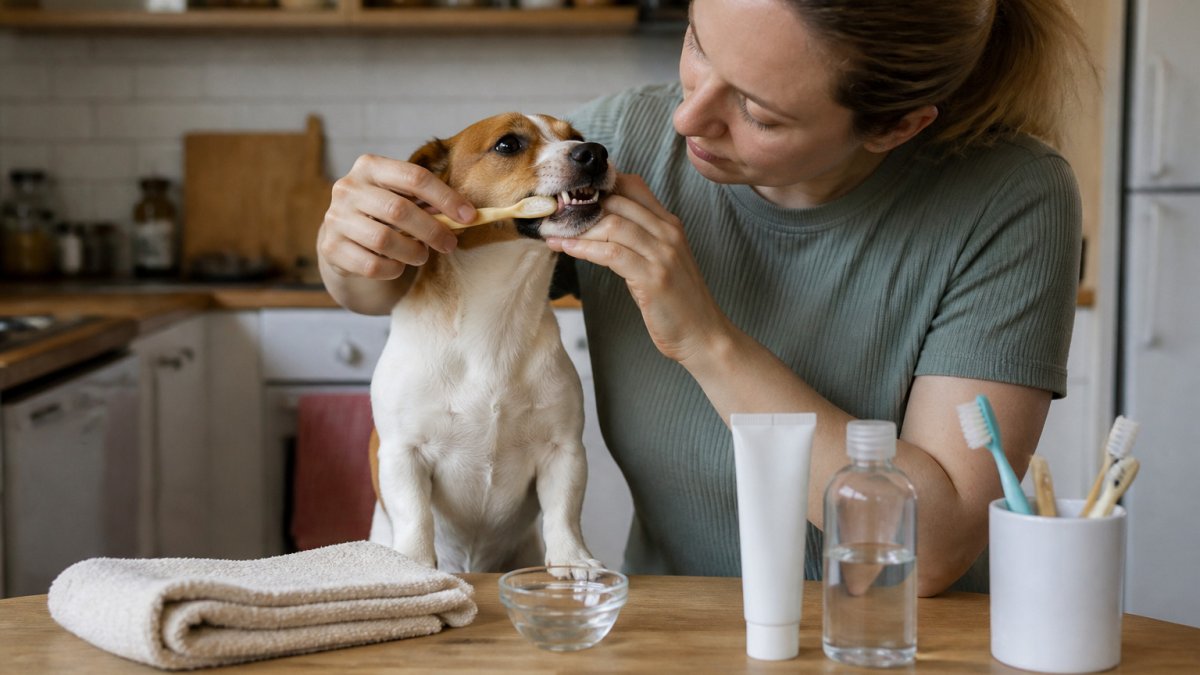
- Choose a quiet time and a comfortable spot, such as a low counter or a lap.
- Let your dog smell and lick a small amount of pet-safe toothpaste.
- Lift the lip gently and brush the outer surfaces of the teeth in small circles.
- Focus on the back molars, where tartar tends to build up.
- Stop before your dog becomes stressed, and reward calm behavior.
Our 3-Sided Dog Toothbrush is designed for this routine. It has a 3-sided head that cleans the top, left, and right surfaces of each tooth in one stroke, along with soft nylon bristles and an easy grip handle. You can find it here: 3-Sided Dog Toothbrush.

Watch out: never use human toothpaste on a dog, because many contain xylitol or fluoride that can harm pets.
Dog Dental Care Products Compared: Brushes, Wipes, Gels, Chews and Water Additives
Not every product on the shelf works the same way, and treating them as interchangeable is how owners waste money. The useful question is not "which product is best" but "what does this product actually do mechanically, and what evidence supports it?"
Brushes: the mechanical standard. A toothbrush works by physically disrupting soft plaque before it mineralizes. That mechanical action is why brushing is the method most veterinary sources point to first. Bristles need to reach the gumline and the outer surfaces of the teeth, especially the back molars. Our 3-Sided Dog Toothbrush is built around that idea: a 3-sided head cleans the top, left, and right surfaces of each tooth in one stroke, with soft nylon bristles and a grip handle that is easy to hold. You can find it here: 3-Sided Dog Toothbrush.
Wipes and gels: lower friction, lower mechanical removal. Finger wipes and gels are useful for pets that will not tolerate a brush. They can help remove some surface plaque and deliver ingredients to the gumline, but they generally provide less mechanical disruption than bristles. Think of them as a bridge to brushing, not a permanent substitute, unless your veterinarian specifically recommends them for your pet.
Chews and toys: adjuncts, not replacements. Dental chews and textured chew toys can help scrub tooth surfaces during chewing and may support breath freshness. Our Dog Molars Pet Toy Ball is a chew toy with a corn-grain design, made from TPU material that is easy to wash. You can see it here: interactive chew toy for tooth cleaning. The trade-off is safety: chews that are too hard can fracture teeth, and chews that are too small can be swallowed. Match size and firmness to your dog, supervise chewing, and retire chews once they are worn.

Water additives: convenience with the weakest evidence base. Water additives are easy to add and require no handling of the mouth, which is why they appeal to owners of resistant pets. Effectiveness varies by product and is not always backed by strong evidence, and some pets refuse treated water. They are best treated as a supplement, not a strategy.
How to read a product claim. Look for a specific mechanism (mechanical abrasion, an active ingredient, a delivery method) rather than a vague "cleans teeth" promise. Acceptance by a dental program does not mean every pet will benefit equally. Ask your veterinarian which category fits your dog's mouth, age, and chewing style before you rely on any single product.
Safety and contraindications. Skip hard antler-style chews and anything that does not give slightly when you press a thumbnail into it. Do not use human toothpaste, many contain xylitol or fluoride that can harm pets. If your dog has a painful or inflamed mouth, loose teeth, or resists having the mouth touched, have a veterinarian assess the mouth before starting home care, because brushing over diseased gums can cause pain and mask the problem.
The main product categories differ in how they work and how strong the supporting evidence is.
| Product type | Mechanism | Role |
|---|---|---|
| Brushes | Mechanical plaque disruption | Method most vets point to first |
| Wipes and gels | Lower mechanical removal | Bridge for pets that resist brushing |
| Chews and toys | Scrubbing while chewing | Adjunct, not a replacement |
| Water additives | Added to drinking water | Weakest evidence; supplement only |
Cost-Benefit: Daily Care Versus Professional Dental Cleanings
The keyword asks whether daily care is worth it, so the honest answer is a cost-benefit comparison, not a slogan. Daily home care and professional cleanings do different jobs, and the math only makes sense when you separate the two.
What daily care actually costs. The bigger cost is time: roughly two minutes a day, or about 12 hours a year.
What a professional cleaning actually costs, and includes. A professional dental cleaning is not a fancy brushing. It typically involves anesthesia, pre-anesthetic bloodwork, scaling above and below the gumline, polishing, a full oral exam with dental radiographs in many practices, and monitoring during recovery. Those steps are why the price is what it is. Costs vary widely by region, practice, and the procedures needed. Rather than quote a single number that will be wrong for most readers, ask your veterinarian for a written estimate that itemizes anesthesia, radiographs, and any expected extractions.
The trade-off, framed honestly. Daily care does not replace a professional cleaning, and a professional cleaning does not replace daily care. What daily brushing can do is slow plaque and tartar accumulation between visits, which may reduce how often tartar-driven problems escalate. What it cannot do is remove tartar that has already mineralized, detect disease below the gumline, or take radiographs. Consistent home care may mean less accumulated tartar at cleanings, but it does not guarantee that, and it does not eliminate the need for exams.
A simple way to think about the return. Compare the annual cost of supplies and time against the cost of treating advanced periodontal disease, which can include multiple extractions, anesthesia, medications, and follow-up visits. You do not need a precise figure to see the asymmetry: prevention is usually the cheaper path, but only if you actually keep the routine. If daily brushing is unrealistic in your household, a consistent several-times-a-week schedule plus professional cleanings is a more honest plan than buying products you will not use.
Where the math changes. Pets with crowded mouths, small breeds prone to retained baby teeth, senior pets, and pets with existing gum inflammation may need professional care on a shorter interval regardless of home habits. In those cases, home care is a supplement to a schedule your veterinarian sets, not a way to defer it.
When Your Vet's Dental Recommendation Outranks Home Care
If your veterinarian recommends a professional dental cleaning, follow that advice, especially if your dog has visible tartar, swollen gums, loose teeth, or signs of pain. Home care is a supplement to veterinary care, not a substitute for it.
Senior dogs often need closer dental monitoring because dental disease can progress with age.
Your Next Step: Starting a Routine You Will Actually Keep
Choose one manageable habit to start this week, such as a short brushing session after dinner, and build from there. The brushes and chew toys mentioned in this guide are available here, so you can get started with a routine that fits your schedule and your dog's comfort.
Frequently Asked Questions
Are dog dental cleanings really necessary?
Professional cleanings are often necessary once dental disease has set in, because tartar below the gumline can only be removed under anesthesia with dental X-rays and scaling. Home care cannot remove hardened calculus. Daily or near-daily brushing, combined with a veterinary dental exam, lowers the chance that you will need extensive treatment. Ask your vet whether your pet's teeth are showing plaque, gingivitis or early periodontal disease, since those findings determine how urgent a cleaning is.
Do dental wipes and gels work for pets?
Wipes and gels can reduce surface plaque, especially for pets that resist brushing, but they generally do not clean as thoroughly as a toothbrush and pet toothpaste. Their effectiveness varies by product, so look for clear veterinary or research support rather than marketing claims. Use them as a practical alternative when brushing is not possible, and keep up with regular veterinary checkups to monitor your pet's gum health.
How often should you brush a dog's or cat's teeth?
Daily brushing is the ideal target, and brushing several times a week is a practical minimum for most pets. Consistency matters more than perfection, because plaque begins forming within a day or two. Keep sessions short, about 30 seconds per side at first, and pair them with a treat so your pet associates brushing with something positive. Build up gradually if your pet is new to tooth brushing.
Can daily brushing prevent professional dental cleanings?
Daily brushing can reduce plaque buildup and may delay the need for professional care, but it cannot fully prevent tartar that has already hardened or disease below the gumline. Many pets still need periodic cleanings under anesthesia, especially as they age or if they have breeds prone to dental problems. Think of home care as the foundation and professional cleanings as a necessary check.
