

How to Safely Transition Pet Diets: 7-Day Schedule

Table of Contents
- Why a Gradual Transition Is Necessary
- The 7-Day Pet Food Transition Schedule
- How to Mix Old and New Food Correctly
- Signs of Digestive Upset in Pets to Monitor
- Transitioning Between Specific Food Types
- Age-Specific Transition Protocols
- When to Consult a Veterinarian About Pet Diet
- Conclusion: Set Your Pet Up for Success
- Frequently Asked Questions
Last Updated: September 5, 2026
Switching your pet's food is a common cause of gastrointestinal upset, yet most owners rush it and end up with vomiting or diarrhea that could have been avoided. A safe change gives gut bacteria time to adapt. At Smitty's Pet Store, we provide practical tips and guidance to ensure your pets stay happy and healthy, and the most important rule is patience. Below, we'll walk you through a proven schedule, mixing ratios, and what to do when things go wrong.
Why a Gradual Transition Is Necessary
A sudden food swap triggers digestive upset because pets' digestive systems produce enzymes tailored to their current diet (PubMed). Introducing a new protein or carbohydrate abruptly leaves the gut lacking the enzymes to break it down, causing loose stools, gas, and discomfort. This is a biological response, not pickiness.
Slow introduction also protects against food intolerance and potential allergic reactions. Many pets develop sensitivities when their immune system is suddenly exposed to a novel ingredient in large quantities. A gradual transition gives you time to spot adverse reactions while the old food still provides a nutritional safety net.
The 7-Day Pet Food Transition Schedule
The standard transition schedule spans 7 to 10 days, with the most common protocol running one week. This works for most healthy adult dogs and cats and is the approach most veterinarians recommend. But a calendar alone is not enough, the real skill is knowing when to hold, advance, or retreat based on your pet's response.
- Days 1-2: Mix 25% new food with 75% old food. This small introduction lets the digestive system begin adjusting without overwhelming it.
- Days 3-4: Move to a 50/50 ratio of new and old food. Your pet's stomach sensitivity will determine whether this step feels seamless or causes minor soft stools.
- Days 5-6: Increase to 75% new food and 25% old food. By this point, most pets are producing digestive enzymes for the new diet.
- Day 7: Serve 100% new food. Monitor stool consistency closely for the next few days to confirm the transition took hold.
The Stool-Check Rule: Your Pet's Report Card
Before you advance to the next ratio, evaluate the last 24 hours of stool quality using this simple three-tier system:
- Green light (advance as scheduled): Stool is firm, well-formed, and easy to pick up. No gas, no straining, normal appetite.
- Yellow light (hold current ratio): Stool is soft but still holds its shape when picked up, or your pet has mild gas or a slightly reduced appetite. Hold the current ratio for 2 extra days before advancing. Do not move backward yet, your pet is adapting, not failing.
- Red light (retreat one step): Stool is formless, pudding-like, or liquid; your pet is vomiting; or appetite has dropped significantly. Go back to the previous ratio your pet tolerated well, and do not advance again until stool returns to normal for 48 consecutive hours.
The 14-Day Extended Protocol for Sensitive Stomachs
If your pet has a sensitive stomach, inflammatory bowel disease, or has failed a standard transition before, use this extended schedule:
- Days 1-3: 10% new food mixed with 90% old food
- Days 4-6: 25% new food / 75% old food
- Days 7-9: 50% new food / 50% old food
- Days 10-12: 75% new food / 25% old food
- Days 13-14: 100% new food
Each step is smaller and held longer, giving the gut microbiome more time to shift its enzyme production and bacterial populations. Most practitioners find that adding a canine or feline probiotic, look for one containing Enterococcus faecium or Lactobacillus acidophilus, during the first 10 days significantly reduces the likelihood of loose stools (PubMed).
When to Abort the Transition Entirely
Sometimes the transition fails, and that is okay. If your pet develops diarrhea lasting more than 48 hours at any ratio, vomits repeatedly, or refuses to eat for more than 24 hours, stop the new food completely and return to 100% of the old diet. Wait until stool is normal for 3-5 days before attempting a different new food. If the second attempt fails the same way, the issue is likely the ingredient profile itself, not the speed of transition, and you should discuss alternative formulas with your veterinarian.
How to Mix Old and New Food Correctly
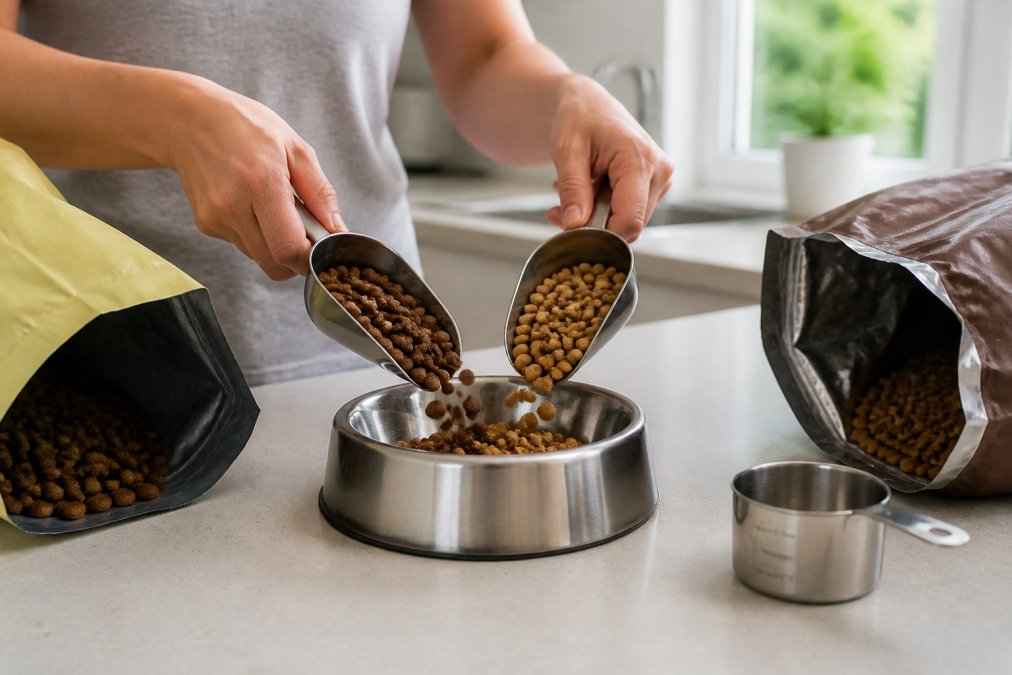
Proper mixing is about accuracy. Use a measuring cup to portion both foods by volume so the ratio stays consistent, since inconsistent ratios can cause intermittent upset. Combine both foods thoroughly so your pet cannot selectively eat only the new kibble.
For wet food and kibble combinations, warm the wet food slightly to release aroma and improve palatability, then mix it evenly through the dry kibble. This prevents your pet from licking off the wet food and leaving the dry pieces behind. If you are using an automatic pet feeder, pre-mix each day's portions into separate containers labeled by day.

Signs of Digestive Upset in Pets to Monitor
Monitoring your pet during the switch is non-negotiable, and stool consistency is your most reliable early warning signal. Healthy transition stools remain formed; soft serve or liquid stool means you are moving too fast. Other signs include vomiting, flatulence, a sudden drop in appetite, or abdominal gurgling.
Mild soft stool for one day often resolves on its own if you hold the current ratio steady. However, diarrhea lasting more than 48 hours, vomiting more than once in 24 hours, or refusal to eat for a full day warrants immediate action. Revert to the previous tolerated ratio and consult your veterinarian if symptoms persist.
The 24-Hour Troubleshooting Checklist
When digestive upset appears, work through this checklist in order:
- Confirm the ratio was correct. Did you accidentally mix 50% new food instead of 25%? A measuring error is the most common cause of unexpected upset. Verify your portions before assuming the food itself is the problem.
- Check for non-dietary causes. Did your pet get into the trash, eat a table scrap, or chew on something outdoors in the last 48 hours? Dietary transitions often get blamed for upsets that actually came from elsewhere.
- Withhold food for 12 hours (adult pets only). For adult dogs and cats over one year old, a 12-hour fast gives the gastrointestinal tract time to reset. Do not fast puppies, kittens, or senior pets with chronic conditions. Always provide fresh water during the fast.
- Reintroduce a bland meal. After the fast, offer a small meal of boiled white meat chicken (no skin, no bones) and plain white rice, or canned pumpkin (not pie filling) mixed with the old food. Feed half the normal portion size.
- Reassess after 24 hours. If stool improves, resume the transition at the last tolerated ratio. If stool does not improve, or if vomiting resumes, call your veterinarian.
Hydration: The Overlooked Danger
Diarrhea and vomiting cause fluid loss faster than most owners realize. A 20-pound dog losing 5% of body weight in fluids, about 16 ounces, is already clinically dehydrated. Signs include:
- Dry or sticky gums
- Loss of skin elasticity (gently pinch the skin between the shoulder blades; it should snap back immediately)
- Sunken eyes
- Lethargy or weakness
- Decreased urination (fewer than 2-3 times per day)
If you see any of these signs alongside diarrhea or vomiting, do not wait for the 48-hour mark. Call your veterinarian immediately. Never give human anti-diarrheal medications, many are toxic to pets.
The Persistent Symptom Decision Matrix
| Digestive Sign | Duration | Action | When to Call the Vet Immediately |
|---|---|---|---|
| Soft stool, no vomiting | 1-2 days | Hold current ratio for 2 extra days | Not needed |
| Diarrhea (formless or liquid) | Less than 24 hours | Fast for 12 hours, then bland meal | If dehydration signs appear |
| Diarrhea | 24-48 hours | Revert to old food; bland diet | If no improvement after 24 hours of bland diet |
| Diarrhea | More than 48 hours | Stop new food; call vet | Immediately |
| Vomiting once | Isolated event | Withhold next meal; offer water | If vomiting recurs within 12 hours |
| Vomiting multiple times | Within 24 hours | Stop new food; call vet | Immediately |
| Blood in stool (bright red or dark/tarry) | Any | Stop new food; call vet | Immediately |
| Refusal to eat | More than 24 hours | Revert to old food; try hand-feeding | If still refusing after 24 hours |
Transitioning Between Specific Food Types
Switching from kibble to raw or wet to dry requires extra care because moisture content and digestibility differ dramatically. Kibble-to-raw introduces a higher protein and moisture load; many practitioners recommend extending the schedule to 14 days, starting with 10-15% raw mixed thoroughly into the kibble. Expect a palatability period where your pet sniffs and walks away before eating.
Wet-to-dry transitions are generally easier because dry food is less rich, but the drop in moisture means you must monitor hydration closely. Add water to the dry kibble for the first week to maintain daily intake levels. Raw-to-kibble transitions can be the trickiest, as the digestive system must shift from high-moisture, enzyme-rich food back to processed kibble; a 14-21 day schedule with probiotics is often necessary to prevent loose stools.
Age-Specific Transition Protocols
Puppies and kittens have developing digestive systems with fewer enzymes, so their transitions should never run shorter than 10 days. Start puppies on a 25% new food ratio for three full days before increasing, and watch for growth rate changes. Senior pets often have reduced enzyme output and may benefit from a probiotic during the transition.
Adult pets in their prime typically handle the standard 7-day schedule without issue, but breed and individual variation matter. Large-breed dogs are more prone to bloat, so keep meal sizes consistent and avoid exercise for an hour after eating. For senior cats with chronic kidney concerns, discuss any dietary change with your veterinarian first.
When to Consult a Veterinarian About Pet Diet
Involve a veterinarian before starting if your pet has a chronic condition such as diabetes, kidney disease, or pancreatitis, since a dietary change can alter medication needs. If your pet is pregnant, nursing, or under one year old, professional guidance ensures the new food meets nutritional requirements. During the transition, contact your vet immediately for repeated vomiting, bloody stool, or dehydration signs.
Suspected food allergies also warrant a vet consult. If your pet develops itchy skin, ear infections, or persistent gastrointestinal upset during the transition, these may signal an allergic reaction rather than simple adjustment. Your vet can distinguish between intolerance and allergy, and may recommend a hydrolyzed protein diet or an elimination trial.
Conclusion: Set Your Pet Up for Success
Transitioning your pet's food does not have to be stressful, but it requires discipline and close observation. Stick to the 7-day schedule, adjust the pace based on stool quality, and slow down when your pet's digestive system sends a warning signal. For sensitive stomachs, extending the timeline and adding probiotics can make the difference between a smooth switch and a messy one.
At Smitty's Pet Store, we believe confident pet parenting starts with the right tools and the right knowledge. Pair your new food with a slow feed bowl ($26.22) to prevent gulping and indigestion, or use an automatic pet feeder with timer ($46.65) to keep portion control consistent while you are at work. Get started with Smitty's Pet Store and give your pet the gift of a comfortable, healthy transition.

Frequently Asked Questions
How long should a pet food transition take?
A standard pet food transition takes 7 days. Start by mixing 25% new food with 75% old food for the first two days. On days 3-4, use a 50/50 mix. Days 5-6 should be 75% new food and 25% old food. By day 7, you can serve 100% of the new diet. This gradual transition pet diets schedule gives your pet's digestive system time to adapt to the new nutrient profile.
What happens if you don't slowly transition pet food?
Switching food abruptly can cause gastrointestinal upset. Common signs of digestive upset in pets include vomiting, diarrhea, flatulence, and a sudden loss of appetite. The sudden dietary change disrupts the balance of bacteria in the gut. In some cases, it can also trigger a food intolerance or allergic reaction. Following a gradual transition schedule is the safest way to prevent these uncomfortable symptoms.
Can I switch my pet's food abruptly if they seem fine?
Even if your pet appears fine after an abrupt switch, you are taking an unnecessary risk. Digestive issues can appear 24 to 48 hours later. A sudden change in the nutrient profile and ingredient source can cause metabolic adjustment problems that are not immediately visible. A slow introduction over a week is always the safer approach, as it allows you to monitor stool consistency and appetite before fully committing to the new food.
What should I do if my pet has diarrhea during the transition?
If your pet develops diarrhea or vomiting, slow the transition down. Go back to the previous mixing ratio that your pet tolerated well, such as a 75% old and 25% new mix. Hold that ratio for a few extra days before increasing the new food again. Ensure fresh water is always available to prevent dehydration. If symptoms persist for more than 48 hours, you should consult a veterinarian about pet diet changes.
This article was written using GrandRanker