

How to Manage Multiple Pet Needs Safely

Table of Contents
- How to Manage Multiple Pet Needs Safely: A Foundation
- Step 1: Create Individual Space and Establish Boundaries
- Step 2: How to Prevent Resource Guarding Between Pets
- Step 3: Pet Feeding Schedule Templates for Multiple Animals
- Step 4: Managing Pet Health Records for Multiple Animals
- Step 5: Pet Proofing for Multiple Species
- Step 6: Monitor Behavioral Cues and Stress Signals
- Step 7: Emergency Evacuation Planning for Multi-Pet Households
Last Updated: August 10, 2026
How to Manage Multiple Pet Needs Safely: A Foundation
Managing multiple pet needs safely requires deliberate planning around resource guarding, health protocols, behavioral monitoring, and physical separation. Without structure, conflicts escalate, health records get lost, and stress signals go unnoticed until they become serious problems.
This guide walks you through the exact steps to manage multiple pet needs safely, from creating individual spaces to emergency evacuation planning.
Step 1: Create Individual Space and Establish Boundaries
Individual space is a foundation for safety. Each pet needs a zone where they can retreat without triggering territorial behavior or conflict. Use a combination of baby gates, crates, and designated zones. Baby gates allow visual separation while maintaining household flow. A crate becomes a safe den for a dog or rabbit. A high shelf or cat tree gives cats vertical territory away from other pets.
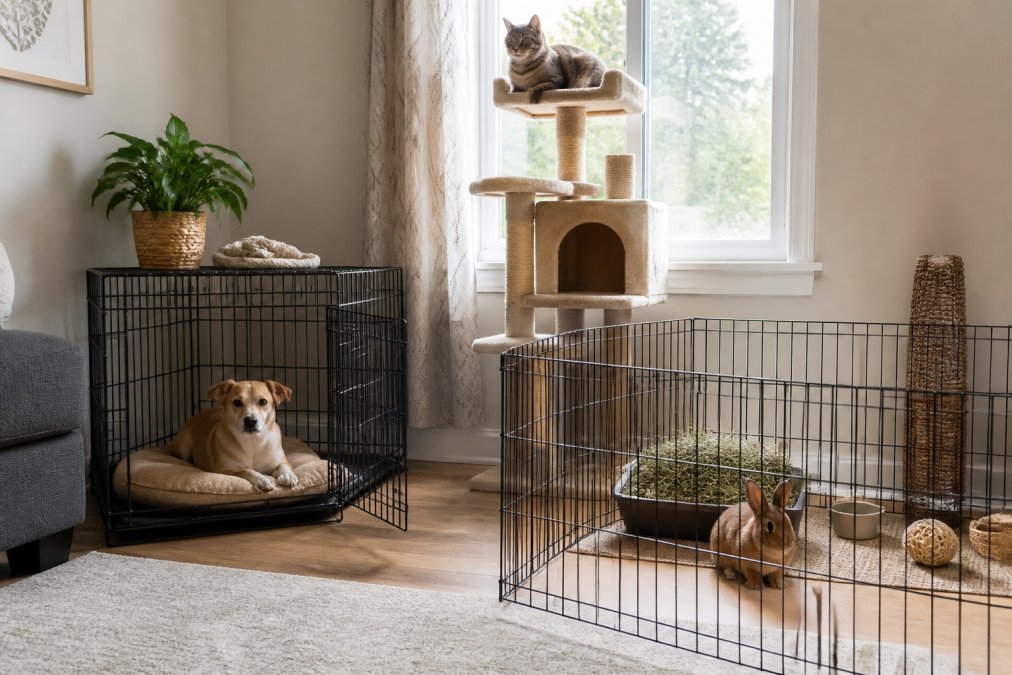
Set boundaries around these spaces consistently. If you have a dog and cat, the cat's high perches should be off-limits to the dog. The rabbit's pen should have a gate the dog cannot push through. Enforce these boundaries every time, not occasionally. Supervised play happens in shared spaces. Unsupervised time happens in separate zones. This prevents accidents and reduces stress signals that escalate into conflict.
Step 2: How to Prevent Resource Guarding Between Pets
Resource guarding, when a pet becomes possessive over food, toys, or space, is one of the fastest ways conflict develops in multi-pet households. The problem isn't that one pet is "mean", it's that their survival instinct is triggered because they perceive a threat to resources they need.
Never feed pets in the same space at the same time. Separate rooms, separate times. A dog eating in the kitchen while a cat eats in the bedroom means neither animal feels competition. Remove food bowls immediately after eating. Don't leave them out for grazing.
High-value items like toys and chews require the same logic. If you have a dog who guards rawhides, that dog doesn't get rawhides in shared spaces. Rotate items so no pet feels like another is stealing their prize.
Watch for early behavioral cues: stiff posture around food, eating faster when another pet is nearby, standing over a bowl, or blocking access to toys. Address these early warnings by implementing stricter separation before they escalate into actual conflict.
Step 3: Pet Feeding Schedule Templates for Multiple Animals
A feeding schedule template keeps everyone on the same page. Include meal times, portion sizes, dietary restrictions, and which pet eats where. Post this on your refrigerator or use a shared digital calendar. Mark off meals as you complete them to prevent double-feeding.
| Pet | Meal 1 Time | Meal 1 Location | Meal 1 Amount | Meal 2 Time | Meal 2 Location | Meal 2 Amount | Notes |
|---|---|---|---|---|---|---|---|
| Senior Dog | 7:00 AM | Kitchen | 1.5 cups | 5:00 PM | Kitchen | 1.5 cups | Joint supplement with breakfast |
| Young Cat | 7:30 AM | Bedroom | 0.5 cup wet + 0.25 cup dry | 6:00 PM | Bedroom | 0.5 cup wet + 0.25 cup dry | Separate from dog |
| Rabbit | 8:00 AM | Living room pen | 1 cup hay + greens | 5:30 PM | Living room pen | 1 cup hay + greens | Fresh water daily |

Adjust portions based on age, activity level, and health status. Store food separately in airtight containers labeled by pet to prevent cross-contamination and make portion control straightforward.
Step 4: Managing Pet Health Records for Multiple Animals
Health records for multiple animals get chaotic fast. Create a master health file, digital or physical, with one section per pet. Include vaccination dates, parasite control schedules, medication history, veterinary contact information, and chronic health issues. Update it every time you visit the vet.
Track vaccination expiration dates, not just what was given. Set phone reminders two weeks before each vaccine is due. Parasite control schedules vary by pet, a dog's monthly flea prevention, a cat's different monthly schedule, and a rabbit's different protocols create multiple dates to track. Write them down.
Stagger veterinary appointments when possible to manage one health situation at a time. Keep medication instructions visible and mark off doses as you give them to prevent missed or double doses.
Step 5: Pet Proofing for Multiple Species
Pet proofing for multiple species means understanding that what's safe for a dog might be toxic for a cat, and what's fine for a cat might be a choking hazard for a rabbit. Chocolate is toxic to dogs but not cats. Lilies are toxic to cats but not dogs. Avocado, grapes, and onions are dangerous for dogs. Certain plants are poisonous to rabbits.
Secure toxic substances separately. Medications, cleaning supplies, pesticides, and certain foods should be in locked cabinets or high shelves. Design storage around your specific pets' abilities.
Choking hazards vary by species. Small objects safe for a cat can kill a rabbit. Toys safe for a dog might be shredded into pieces a cat chokes on. Inspect toys regularly and remove anything with loose parts, tears, or degradation.
Electrical cords, string, rubber bands, and small objects should be out of reach. These cause intestinal blockages in cats and rabbits. Use cord covers, secure loose items, and do regular sweeps of your floor and furniture for hazards.
Step 6: Monitor Behavioral Cues and Stress Signals
Stress signals in pets escalate quickly in multi-pet households. Learn your pets' individual body language. A dog's stiff posture, forward ears, and hard stare signal tension. A cat's flattened ears, dilated pupils, and low body position signal fear or aggression. A rabbit's tooth grinding or thumping hind legs signal distress.
Separation anxiety develops when pets become dependent on each other or stressed by proximity. A dog that panics when separated from a cat, or a cat that becomes destructive when alone, signals that the relationship dynamic needs adjustment.
Document behavioral changes. If a pet's eating habits shift, energy levels drop, or bathroom behavior changes, these are signs of stress. Monitor play interactions. Healthy play has role-reversals. Unhealthy play is one-directional, escalating, or involves pinning or biting. Interrupt play that feels tense.
Step 7: Emergency Evacuation Planning for Multi-Pet Households
Create an evacuation kit for each pet. Include copies of vaccination records, microchip numbers, medications, food, water, bowls, leashes, carriers, and a recent photo of each pet. Store these kits in an easily accessible location, not in a garage or basement.
Carriers are non-negotiable. You cannot safely evacuate multiple pets without individual carriers for each one. Keep them accessible and practice having pets enter carriers before an emergency.
Identify pet-friendly shelters and hotels in advance. Many evacuation shelters don't accept pets. Keep a list of pet-friendly options before you need that information.
Microchip each pet and register the microchips with your contact information. Update registration every time your contact information changes. Have a designated meeting point if you're separated from your pets during evacuation. Tell a trusted friend or family member this location.
Take recent photos of each pet from multiple angles, including distinguishing marks or scars. Keep digital copies in cloud storage and physical copies in your evacuation kit. Discuss pet-related financial planning with your family and know how much you're willing to spend on emergency care for each pet.
Managing multiple pet needs safely is fundamentally about systems, not luck. You need clear boundaries, documented schedules, health records you can access instantly, and the ability to recognize when stress is building before it becomes a crisis. At Smitty's Pet Store, we offer curated supplies designed for multi-pet households and provide practical tips and guidance to help pet parents build these systems. The confidence comes from knowing exactly what each pet needs, when they need it, and how to respond when something changes. Start with one system and build from there.
Frequently Asked Questions
How do I introduce a new pet to a multi-pet household safely?
Introduce new pets gradually over 2-3 weeks. Start by keeping them separated so they can smell each other under doors. Use baby gates to allow visual contact without direct interaction. Feed them on opposite sides of a closed door so they associate good things with each other's presence. Progress to short, supervised meetings in neutral spaces. Watch for positive reinforcement opportunities and reward calm behavior. Never force interaction, let pets set the pace. This slow approach reduces stress signals and prevents territorial behavior from escalating.
What are the signs of resource guarding in pets?
Resource guarding appears as stiff body language, growling, or snapping when another pet approaches food, toys, or resting spaces. Watch for ears pinned back, raised hackles, or blocking access to valued items. Some pets show subtle signs: eating faster when others are near, positioning themselves between a resource and other animals, or staring intensely. These behavioral cues indicate your pet feels threatened. Address resource guarding immediately through separate feeding areas, removing high-value toys during multi-pet time, and consulting a veterinary behaviorist if aggression occurs. Early intervention prevents escalation.
How do I manage individual feeding schedules for multiple pets with different dietary needs?
Use pet feeding schedule templates to track each animal's mealtimes, portion sizes, and dietary restrictions. Feed pets in separate rooms or use baby gates to prevent cross-contamination of food. Establish a consistent routine: senior dogs at 7 AM and 5 PM, younger dogs at 8 AM and 6 PM, cats throughout the day in elevated feeders. Label each bowl with the pet's name. Remove uneaten food within 15 minutes to maintain freshness and prevent disputes. Digital tools or printed charts help busy households stay organized. This prevents one pet from eating another's medication-laced food or specialized diet.
What's the best way to prevent cross-contamination of medications in multi-pet homes?
Store medications in clearly labeled, separate containers for each pet, kept in different cabinet spaces. Maintain detailed health records noting which pet receives what medication and when. Use a medication chart or digital tracking app to log doses. When administering, isolate each pet in a separate room during medication time. Never leave medications unattended where other pets can access them. Keep a current inventory of all prescriptions. This preventative care approach avoids dangerous accidental ingestion and ensures each pet receives the correct treatment for their individual health needs.
This article was written using GrandRanker