

Durable Dog Collars That Survive Strong Pullers: 2026 Guide

Table of Contents
- What Makes a Dog Collar Truly Durable?
- Best Collar Material for Strong Pullers: Leather vs. Nylon
- Top Durable Dog Collars We Recommend for Daily Wear
- How to Measure a Dog for a Collar: Get the Right Fit
- How Often to Replace Dog Collars: Signs of Wear to Watch
- Cleaning and Maintenance Tips for Long-Lasting Collars
- Frequently Asked Questions
Last Updated: September 4, 2026
Few purchases get tested as brutally as a dog collar. A flimsy collar can snap during a sudden lunge, leaving your dog free to bolt toward traffic. In this guide from Smitty's Pet Store, we break down what makes a collar last, which materials hold up to daily strain, and the models we trust for active dogs.

Most collars fail not from chewing but from repeated pulling pressure that stresses the webbing and hardware. We show you what to inspect before you buy and how to spot wear before it becomes a failure, plus measuring, replacement timelines, and cleaning.
What Makes a Dog Collar Truly Durable?
Durability comes down to three components: tensile strength in the material, hardware integrity in the buckle and D-ring, and reinforced stitching. A collar is only as strong as its weakest link, military-grade webbing fails if the buckle is a cheap plastic snap.
The material must resist abrasion from fur, brush, and pavement. Stitching must be dense with bartack reinforcement at the D-ring. Hardware should be welded or solid cast, not folded thin metal. For strong pullers, a collar lacking any of these is a liability.
Best Collar Material for Strong Pullers: Leather vs. Nylon
Leather versus nylon depends on the type of pulling your dog does. A working dog pulling a sled applies steady tension; a reactive dog lunging at squirrels applies sudden force; a chewing puppy applies another kind of stress. Choosing the wrong material means premature failure.
Tensile Strength vs. Abrasion Resistance: Know the Difference
Tensile strength measures force a material withstands before breaking. Nylon webbing typically rates between 4,000 and 8,000 pounds per inch of width (peer-reviewed research). Leather varies by tanning process and hide quality, full-grain bridle leather can match nylon, but split or bonded leather fails far earlier.
Abrasion resistance determines survival against concrete, brush, and fur. Nylon frays when edges catch on rough surfaces; leather scuffs but maintains core integrity longer. For dogs that drag collars along the ground or push through underbrush, leather often outperforms nylon.
Breed-Specific Durability Requirements: Not All Pullers Are Equal
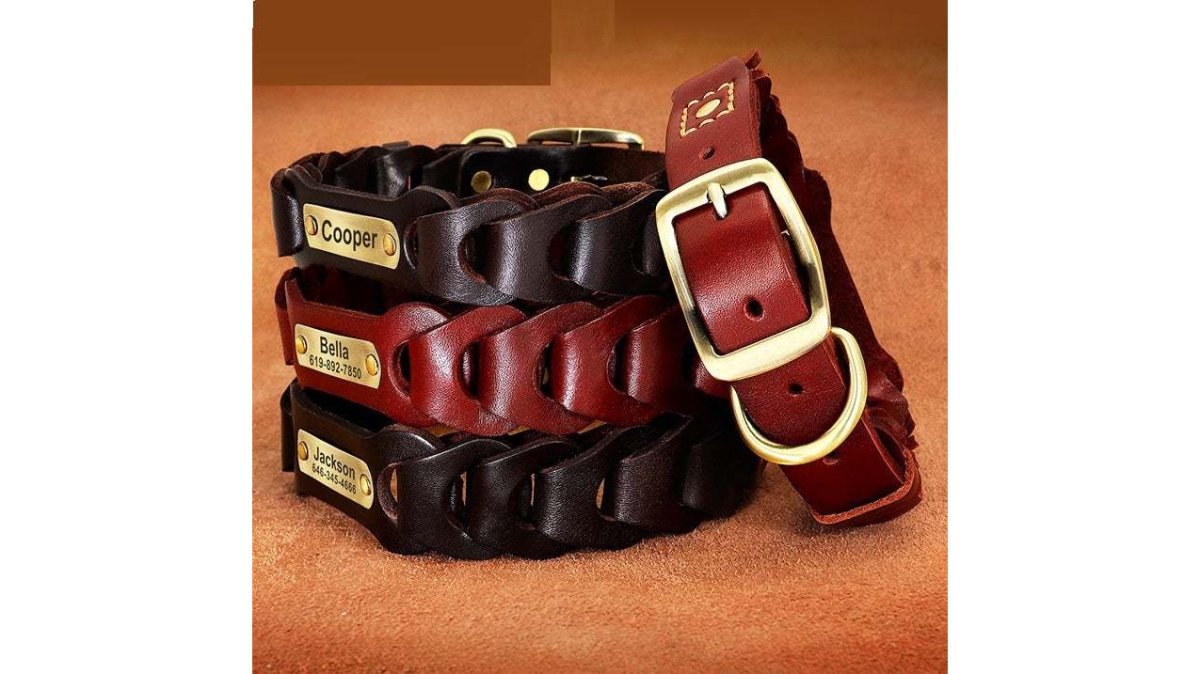
Working breeds with thick necks (Labradors, Pit Bulls, Boxers): These dogs generate pulling force from their entire body mass, a 70-pound dog lunging creates roughly 200-300 pounds of force. Look for 1.5-inch wide materials to distribute force. Braided leather excels because interlocking strands absorb shock better than flat webbing.
Sighthounds and lean pullers (Greyhounds, Whippets): These dogs have narrow necks and can slip out of collars that are too wide. A 1-inch wide, tightly woven nylon with a martingale-style design often outperforms leather because it adjusts precisely and prevents slipping.
Puppies and chewers: No material survives a determined chewer indefinitely. Leather is more vulnerable to puppy teeth than nylon because teeth puncture the hide. For puppies, choose nylon with rolled edges and accept replacement during teething, the strategy is replacement cadence, not material choice.
The BioThane Alternative: What Most Competitors Overlook
BioThane combines a polyester core with a thermoplastic rubber coating, offering leather's abrasion resistance with nylon's weatherproofing (peer-reviewed research). It does not absorb water or odors, never requires conditioning, does not crack in cold weather, and its smooth coating prevents fur matting.
BioThane is stiffer than leather or nylon and does not breathe, making it poor for hot, humid climates. For owners wanting a collar that survives mud, salt water, and daily abuse without maintenance, it is worth serious consideration.
Matching Material to Pulling Style: A Decision Framework
| Pulling Scenario | Recommended Material | Why |
|---|---|---|
| Steady pulling (sledding, carting) | Braided leather | Distributes sustained tension evenly; fibers interlock to resist stretching |
| Explosive lunging (reactive dogs) | Tightly woven nylon | Higher tensile strength per ounce; predictable failure mode (fraying) that is visible before snapping |
| Water sports and swimming | BioThane or coated nylon | Zero water absorption; no odor retention; quick-drying |
| Puppy teething | Flat nylon with rolled edges | Cheaper to replace; less puncture risk than leather |
| All-day wear in hot climates | Breathable nylon mesh hybrid | Prevents heat rash; allows air circulation |
The 6-Month Wear Test: What Actually Happens to Materials
Real durability reveals itself after months of daily use. After six months, nylon collars typically show edge fraying where the leash clip rubs the D-ring. Leather develops a patina, but stitching at the buckle attachment fails first. BioThane shows virtually no visible wear, though the coating can micro-crack if bent at sharp angles in freezing temperatures.
A common pattern among strong pullers is failure at the hardware attachment point, not the material. The webbing may look pristine while the D-ring wears thin from leash clip friction, material choice matters less than hardware quality.
Top Durable Dog Collars We Recommend for Daily Wear
We have selected collars that meet strict criteria for material quality, hardware integrity, and real-world testing. Each option below serves a different primary need, from classic style to high-visibility function.
| Collar | Material | Best For | Price |
|---|---|---|---|
| Braided Leather Dog Collar | Genuine braided leather | Medium to large strong pullers | $40.09 |
| Reflective Camouflage Collar | Nylon | Outdoor visibility, wet conditions | $22.02 |
| Custom Engraved Reflective Collar | Polyester + alloy metal | Personalized ID, daily training | $32.18 |
Braided Leather Dog Collar: Built for Medium and Large Breeds
Our top pick for daily wear is the Braided Leather Dog Collar. Constructed from genuine braided leather, it provides superior tensile strength compared to flat or rolled options and handles powerful breeds like Labradors, Huskies, and Boxers without stretching or breaking.

The smooth inner surface prevents irritation, and the secure buckle keeps it firmly in place. It comes in L and XL sizes and two colors, Red and Brown. At $40.09, it outlasts several cheaper nylon replacements.
Reflective Camouflage Collar: The Weather-Resistant Nylon Option
For dogs near water or in low-light conditions, the Reflective Camouflage Collar is a practical, budget-friendly choice. Made from quick-dry nylon, it resists water absorption and dries fast after a swim. The camouflage pattern is printed on weather-resistant webbing that holds up to mud, rain, and repeated washing.
Reflective threading improves visibility during dawn and dusk walks. Available in sizes S, M, and L with multiple color options, it offers an adjustable fit for growing dogs. At $22.02, it is an accessible option for a reliable backup or primary collar for a moderately active dog.
Custom Engraved Reflective Collar: Personalized and Practical
The Custom Engraved Reflective Dog Collar & Leash Tag solves identification and visibility at once. This polyester collar features an alloy metal tag engraved with your dog's name, gender, birthday, or phone number at no extra cost, eliminating a separate dangling tag that can snag or get lost.

The collar is reflective and adjustable, fitting small to large dogs including Pugs and French Bulldogs. For a clean, all-in-one ID solution that does not compromise durability, it delivers at $32.18, a smart choice for training collars where you want contact information always attached.
How to Measure a Dog for a Collar: Get the Right Fit
Knowing how to measure a dog for a collar is the difference between a secure fit and a safety hazard. Use a flexible measuring tape around the base of the neck, keeping two fingers flat between the tape and the neck for a snug but not tight fit.
For the braided leather collar, add about 2 inches to the neck measurement. A collar too loose can slip over the head; one too tight can cause chafing or restrict breathing (avma.org). Re-measure puppies every few months as neck size changes rapidly.
How Often to Replace Dog Collars: Signs of Wear to Watch
Replacement timing is a stress question, not a calendar one. A collar on a 15-pound Chihuahua may last a decade; the same collar on a 90-pound German Shepherd pulling toward every squirrel may fail within eighteen months. The difference is cumulative force on stress points.
The Three Failure Zones: Where Collars Actually Break
Every collar has three distinct failure zones, each with its own wear pattern and inspection protocol.
Zone 1: The D-ring attachment. This is the most common failure point. The leash clip creates constant friction against the D-ring and its stitching, wearing the metal thin and loosening the bartack. Inspect monthly by flexing the collar and checking for gaps between webbing and D-ring. If you can see light through stitching holes, the collar is compromised.
Zone 2: The buckle and adjustment slide. The buckle prong presses against the same hole repeatedly, stretching it so the buckle no longer seats firmly. The adjustment slide also wears. Check whether the collar holds its size when you tug both ends, if it slips, the friction fit has degraded.
Zone 3: The material body. Nylon frays at edges where it rubs the neck or ground. Leather cracks along fold lines, particularly in dry climates. BioThane develops surface crazing that exposes the polyester core. Run your fingers along the entire collar monthly, feeling for rough spots, thin areas, or stiffness changes.
Replacement Timelines by Usage Pattern
| Usage Pattern | Nylon Collar | Leather Collar | BioThane Collar |
|---|---|---|---|
| Daily walks, moderate puller | 12-18 months | 3-5 years | 3-4 years |
| Daily walks, strong puller | 6-12 months | 2-3 years | 2-3 years |
| Working dog (hunting, herding) | 3-6 months | 1-2 years | 1-2 years |
| Puppy (chewing phase) | 2-4 months | Not recommended | 6-12 months |
| Occasional use (weekend hikes) | 2-3 years | 5-7 years | 4-5 years |
These timelines assume regular cleaning and no visible damage. Any visible defect overrides the timeline, replace immediately regardless of age.
The Bend Test: A 10-Second Field Inspection
A simple bend test reveals more about collar condition than visual inspection. Hold the collar at the D-ring attachment and bend it backward at a 90-degree angle. A healthy collar bends smoothly and returns to shape; a compromised one feels stiff, cracks audibly, or shows white stress marks.
Repeat at the buckle and midpoint, where material fatigue concentrates. If any bend produces cracking or visible whitening, the collar's structural integrity is compromised even if it looks fine.
The Hardware Corrosion Checklist
Metal hardware fails differently than webbing. Check the D-ring and buckle for these specific signs:
- Pitting: Small dark spots on the metal surface indicate corrosion beginning beneath the plating. Once pitting starts, the metal will continue to degrade even with cleaning.
- Color change: A dull, grayish tint on a previously shiny buckle suggests the protective plating has worn through.
- Rough edges: Run your finger around the D-ring's inner surface. Any roughness means the metal is wearing thin and may develop a sharp edge that cuts the leash.
- Buckle spring tension: A buckle that requires noticeably more force to open than when new has a weakening spring. This is a safety hazard because the buckle may release unexpectedly during a hard pull.
The Replacement Decision Framework
Ask yourself three questions when evaluating any collar:
- Has the collar been through a high-stress event? A collar that stopped a dog from bolting into traffic has absorbed forces far beyond normal walking. Even if it looks fine, replace it.
- Is the collar more than two years old? Materials degrade from UV exposure, temperature cycling, and repeated flexing. Age alone is reason for replacement.
- Would you trust this collar to hold your dog if a deer ran across the trail? If you hesitate, replace it before the situation arises.
Keeping a Spare: The Backup Collar Strategy
Owners of strong pullers should keep a spare collar in the car or by the door. When the primary shows any sign of wear, swap in the spare immediately and order a replacement. The spare need not match, a basic nylon collar in the correct size suffices, as long as it is rated for the dog's pulling force and inspected with the same rigor.
Cleaning and Maintenance Tips for Long-Lasting Collars
Regular cleaning is the cheapest way to extend any collar's life. For nylon and polyester, hand wash in warm water with mild soap and hang to dry. Avoid machine washing, which stresses stitching and hardware finish.
Leather collars require a different approach. Wipe with a damp cloth to remove dirt and sweat salts. Apply leather conditioner every few months to keep the material supple and prevent cracking, particularly in dry climates or winter months.
A durable collar is an investment in your dog's safety and your peace of mind. Smitty's Pet Store offers a curated selection chosen for material integrity and hardware quality, from braided leather for strong pullers to reflective nylon for night walks. Explore our collection and equip your dog with a collar built to last.
Frequently Asked Questions
Are nylon or leather collars more durable?
For strong pullers, the best collar material depends on the dog. High-quality braided leather, like the Braided Leather Dog Collar at Smitty's Pet Store, offers superior tensile strength and ages well, becoming more supple without losing integrity. Durable nylon webbing is also strong, weather-resistant, and quick-drying, but it can fray over time and may cause friction burns on dogs that lunge. Leather can be comfortable for daily wear and resistant to snapping under pressure, while nylon excels in wet conditions. Choose leather for heavy pulling and long-term durability.
How do I know if a durable dog collar is strong enough for my breed?
A collar is strong enough if it can withstand your dog's pulling pressure without breaking. For large breeds like German Shepherds or Rottweilers, look for collars with reinforced stitching and heavy-duty hardware, like a secure buckle and wide D-ring. The collar width should be proportional to your dog's neck; wider collars distribute pressure better. Check that the material, such as braided leather from our store, has high break-strength and the hardware is corrosion-resistant. When in doubt, size up and choose a collar designed for large breeds.
What is the best dog collar for everyday wear?
The best everyday collar balances comfort with durability. For most dogs, a well-made leather collar, such as our Braided Leather Dog Collar, can be an excellent choice because it is comfortable against the skin, gets softer with age, and holds up well to daily use. If your dog swims often, a quick-dry, weather-resistant nylon collar with a reflective strip is more practical. Ensure the collar has a smooth inner lining to prevent chafing and a secure closure so it stays put during walks. Rotate between collars if your dog is very active.
This article was written using GrandRanker