

Choose a Travel Crate for Nervous Rescue Dogs

Table of Contents
- Assess Your Rescue Dog's Anxiety and Suitability for Crating
- Dog Travel Crate Size Guide: Measure and Match
- Soft-Sided vs Hard-Sided Dog Crate: Which Suits Your Rescue
- Safety, Ventilation, and Vehicle Placement
- How to Crate Train a Rescue Dog Before Travel
- Choosing for Different Travel Modes and Conditions
- Escape Prevention and Durability for Determined Rescues
- Frequently Asked Questions
Last Updated: October 19, 2026
Assess Your Rescue Dog's Anxiety and Suitability for Crating
Choosing a travel crate for nervous rescue dogs starts with understanding what you're dealing with when selecting the right travel crate nervous rescue dogs need. Not every rescue dog is ready for crating, and forcing the issue can backfire. At Smitty's Pet Store, we provide practical tips and guidance to ensure your pets stay happy and healthy. The first step isn't picking a crate type, it's deciding whether crating is right for your dog.
Signs of confinement anxiety in rescue dogs
Confinement anxiety in rescue dogs shows up predictably: pacing, whining or barking when the door closes, escape attempts, excessive drooling, or accidents despite housetraining. Some dogs pant heavily, tremble, or shut down completely.
The key difference between normal discomfort and genuine anxiety is intensity and persistence. A dog that settles after 10 minutes has adjustment stress; one that escalates for hours has confinement anxiety.
Rescue dogs often arrive with zero crate experience. Their anxiety isn't always about the crate itself, it's about loss of control, unfamiliar spaces, or past trauma.
When a travel crate is appropriate
A travel crate is appropriate when your dog can stay calm or at least manageable during confinement. If your dog escalates into panic, a crate becomes a trap, not a safety tool.
Travel crates work best for:
- Dogs with mild to moderate anxiety who respond to gradual training
- Dogs that have learned to settle in enclosed spaces
- Dogs you can introduce to crating slowly, over weeks or months
- Dogs whose anxiety stems from novelty rather than deep trauma
Travel crates are NOT appropriate for:
- Dogs with severe panic responses to confinement
- Dogs with a history of escape injuries or self-harm in crates
- Dogs showing signs of trauma-related shutdown or aggression
- Dogs whose anxiety doesn't improve after weeks of gradual exposure
If your rescue dog falls into the "not appropriate" category, talk to a veterinary behaviorist. Medication, desensitization, or alternative containment may be necessary first. Forcing a severely anxious dog into a crate can damage your relationship and worsen anxiety.
Dog Travel Crate Size Guide: Measure and Match
Getting the size right is non-negotiable. Too small causes panic and discomfort; too big defeats containment and safety. The rule: your dog needs enough space to stand up, turn around, and lie down comfortably, and nothing more.
How to measure your rescue dog accurately
Measure your dog with a soft measuring tape while your dog is standing naturally. You need three measurements:
Length: Measure from the tip of your dog's nose to the base of the tail (where the tail connects to the body, not the end of the tail). Add 4 inches.
Height: Measure from the ground to the top of your dog's head when standing. Add 2-3 inches for clearance.
Width: Measure your dog's chest at the widest point. Add 4-6 inches so your dog can turn around without scraping sides.
Write these numbers down as your baseline for every crate you consider. If you're adopting and don't know the adult size yet, measure what you have now and plan to upgrade. Buying one oversized crate hoping your dog grows into it wastes money and creates safety problems during travel.
Sizing for comfort: stand, turn, and lie down
If your dog can only lie down in a tight curl, the crate is too small. If there's room for three full steps in any direction, it's too large.
Test the fit by watching your dog move inside the crate. Comfort is the foundation of acceptance; a physically uncomfortable dog will never relax, no matter how much training you do.
Soft-Sided vs Hard-Sided Dog Crate: Which Suits Your Rescue
The crate type matters because different materials serve different purposes. Hard-sided crates offer security and durability. Soft-sided carriers offer visibility and portability. For nervous rescue dogs, the choice depends on what your dog needs to feel safe.
Hard-sided, wire, and collapsible options
Hard-sided plastic crates (kennels) offer solid walls that block visual stimulation, providing a den-like environment for dogs that get anxious seeing everything around them.
Wire crates offer full visibility, which can reduce panic for dogs with separation anxiety because they're not isolated. They fold flat for storage and are lighter to move, but they don't reduce visual stimulation, and some dogs find them less secure-feeling.
Collapsible crates (wire frames with fabric covers) split the difference. The Foldable Heavy-Duty Dog Cage from Smitty's Pet Store, available in five sizes from 35 × 25 × 33 cm to 85 × 60 × 70 cm, combines durable iron wire construction with a foldable design that collapses flat for transport.

Soft-sided carriers for anxious dogs
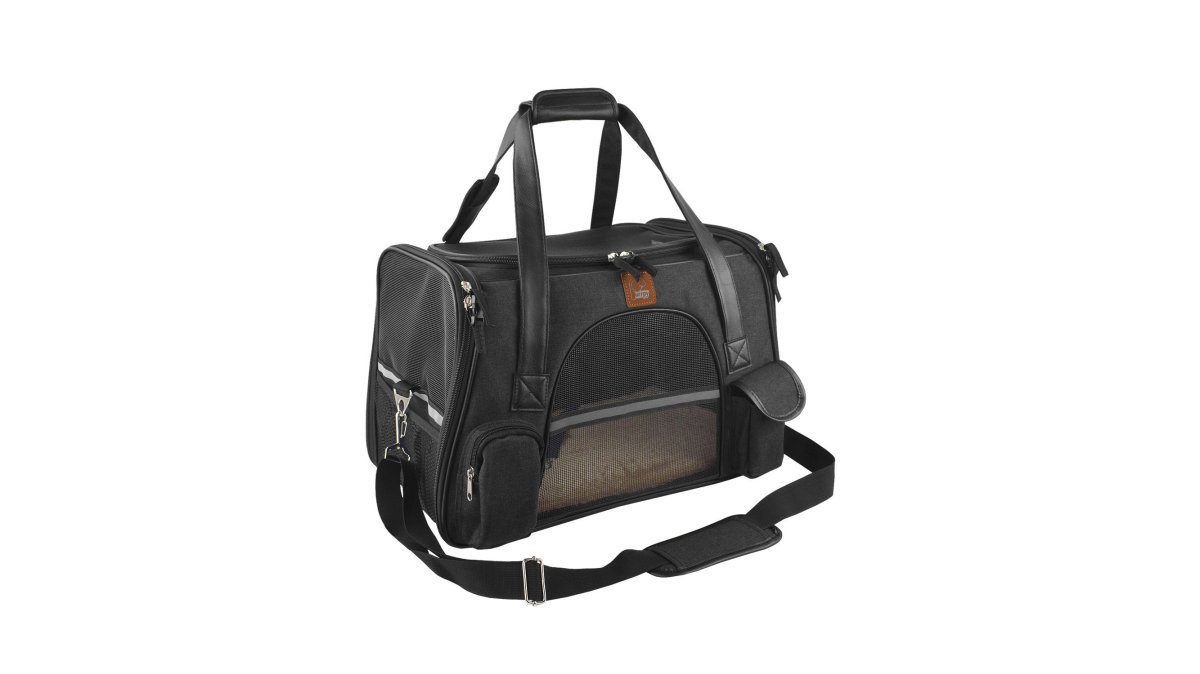
Soft-sided carriers prioritize comfort and portability. They're lighter, easier to move in and out of vehicles, and often feel less cage-like. The Stylish Pet Car Carrier from Smitty's Pet Store ($80.19) features breathable mesh panels, car seat-ready straps to prevent sliding, and an included cushion.
For nervous dogs, mesh visibility helps: your dog sees you and the environment, reducing isolation anxiety. Soft-sided carriers also compress slightly, which some anxious dogs find calming. The trade-off: they're less secure for determined escape artists.
Safety, Ventilation, and Vehicle Placement
A crate is only safe if it's properly secured in the vehicle and designed for airflow. A loose crate becomes a projectile in a sudden stop. Poor ventilation causes heat stress and panic.
Foldable Heavy-Duty Dog Cage →
Secure placement and restraint in the car
The crate must be secured so it doesn't slide, tip, or move during acceleration, braking, or turns. Unsecured crates are dangerous for your dog and distracting for you.
Placement options:
- Rear cargo area (SUVs, hatchbacks): Wedge the crate snugly against the back seat and secure with cargo straps or a safety gate
- Back seat: Use a seat belt to secure the crate frame, or use a car seat carrier designed to anchor to seat belt systems
- Passenger seat: Only for small carriers, and only if you can secure them properly
The Dog Car Seat Carrier from Smitty's Pet Store ($57.75) solves this for small dogs.

Never place a crate in the front seat. Airbag deployment can injure or kill a dog in a crate. Never let a crate roll around loose in the cargo area, it becomes a battering ram in a crash.
Airflow, visibility, and reducing visual stimulation
Ventilation prevents heat stress and panic.
Visibility matters for your dog's anxiety level. Dogs with separation anxiety need to see you or out the window; dogs with sensory overload need reduced visual input.
How to Crate Train a Rescue Dog Before Travel
Crate training a travel crate nervous rescue dogs need takes time. Don't rush it. A dog forced into a crate before it's ready develops lasting fear and anxiety; a dog trained gradually learns to see the crate as a safe space.
Gradual acclimation: a step-by-step process
Week 1: Introduction and door open Leave the crate door open in a room where your dog spends time.
Week 3: Your presence, door closed Close the door for 1-2 minutes while you sit nearby. Reward calm behavior.
Week 5-6: Longer absences and vehicle introduction Work up to 15-30 minutes in the crate while you're gone.
This timeline assumes steady progress. Some rescue dogs need 8-12 weeks. Don't move faster than your dog's anxiety allows.
Creating comfort: bedding, toys, and familiar scents
Make the crate a comfortable space, not a punishment box. Add soft bedding, a favorite toy, and something with your scent (an old t-shirt) to reduce anxiety. Never use the crate as a timeout or punishment, never chase your dog into it, and never force the door shut while your dog is panicking. Some rescue dogs calm down faster with a crate cover that blocks visual stimulation; others need to see out. Experiment and watch your dog's response.
Choosing for Different Travel Modes and Conditions
Not every crate works for every travel situation. A crate that's perfect for car travel might be impractical for air travel. A crate that's portable might not be secure enough for highway driving.
Car travel vs. air travel vs. road trips
Car travel: Prioritize secure placement and ventilation. Hard-sided or collapsible crates work well. The crate must be anchored to prevent sliding. Air flow is critical because vehicles heat up quickly.
Air travel: Airlines have strict crate requirements. Most require hard-sided crates that meet specific dimensions. Check your airline's rules before buying. Soft-sided carriers usually aren't approved for cargo hold travel.
Road trips (multi-day car travel): Portability matters. The Breathable Pet Carrier Bag from Smitty's Pet Store ($111.27) offers a unique option for smaller dogs and cats.
Portability, setup time, and storage
Collapsible crates win on portability: they fold flat, take minimal storage space, and set up in minutes. Hard-sided crates are heavier and bulkier but more durable. Soft-sided carriers are lightweight but less secure for determined escape artists. If you travel frequently, portability matters; if the crate is mainly for home with occasional car trips, durability and comfort matter more. Wire and collapsible crates set up in 2-5 minutes, hard-sided crates take 5-10 minutes, and soft-sided carriers are ready to use immediately.
Escape Prevention and Durability for Determined Rescues
Some rescue dogs have a strong drive to escape. They'll chew through fabric, bend wire, and test every latch, so crate selection is about security, not comfort. Hard-sided crates with secure latches are your best bet: the plastic is harder to damage than fabric or thin wire, and latches should resist manipulation by a determined dog.
Choosing a travel crate for nervous rescue dogs means matching the crate type to your dog's anxiety, securing it properly in your vehicle, and training your dog gradually before travel. Smitty's Pet Store offers curated options like the Foldable Heavy-Duty Dog Cage, Dog Car Seat Carrier, Stylish Pet Car Carrier, and Breathable Pet Carrier Bag, each designed for different travel needs and anxiety levels.

Frequently Asked Questions
How do I know if my rescue dog is suitable for a travel crate?
Not all dogs thrive in crates, especially rescues with trauma histories. Watch for signs of confinement anxiety: panting, whining, destructive behavior, or attempts to escape. If your dog shows severe distress, consult a veterinary behaviorist before forcing crate use. A good sign of suitability is your dog voluntarily entering the crate and resting calmly. Start with short, positive exposures in a stationary crate at home before attempting car travel.
What size travel crate does my rescue dog need?
Measure your dog from nose to tail tip (length), floor to top of head standing (height), and widest point across the chest (width). Your dog should stand, turn around completely, and lie down comfortably without touching the crate walls. A crate that's too large reduces the den-like security nervous dogs need; too small causes physical stress. The Foldable Heavy-Duty Dog Cage comes in 5 sizes from 35 × 25 × 33 cm to 85 × 60 × 70 cm, covering small rescues through large dogs.
Are soft-sided or hard-sided crates better for nervous rescue dogs?
Soft-sided carriers offer visibility and lighter weight, which can reduce anxiety by letting your dog see you and their surroundings, reducing the sense of isolation. Hard-sided crates provide more security and durability for escape-prone rescues. Wire crates offer airflow and visibility. Choose based on your dog's specific anxiety: if your rescue fears confinement, a soft-sided carrier with mesh panels may help; if they're escape artists, a hard-sided or heavy-duty wire crate like our Foldable Heavy-Duty Dog Cage ($231.98) provides security.
How long does it take to crate train a rescue dog for travel?
Gradual acclimation typically takes 2-4 weeks, though rescue dogs with severe anxiety may need 6-8 weeks. Start by leaving the crate open in your home with treats and toys inside, no pressure to enter. Reward voluntary entry with praise and treats. Gradually close the door for seconds, then minutes, while you're nearby. Only move to car travel once your dog rests calmly in the stationary crate for 30+ minutes. Rushing this process increases anxiety and travel stress.