

Cat Enrichment Station: How to Set One Up at Home

Last Updated: November 1, 2026
Quick Summary
To set up a cat enrichment station, pick a quiet corner with a window and divide it into four zones: a vertical zone with a cat tree or shelves, a hide zone with a covered bed, a food zone with puzzle feeders on a washable mat, and a play zone with rotating toys. Anchor the cat tree first, introduce your cat slowly, and run a safety check before they explore.
- A station can work in as little as a 3-by-3-foot corner away from foot traffic.
- Anchor tall cat trees to the wall or a sturdy base before your cat explores.
- Swap out 3-4 toys weekly and wash puzzle feeders weekly to keep novelty high.
- Two cats sharing a station need two hides, two feeding spots, and two climbing routes.
- Seniors and cats with arthritis need ramps, low perches, and feeders at floor level.
Table of Contents
- Why Every Indoor Cat Needs an Enrichment Station
- Indoor Cat Enrichment Ideas That Cover All Five Senses
- Choosing the Right Spot and Setting Up Your Station Step by Step
- Cat Enrichment Toys, Puzzle Feeders, and Sensory Extras
- Safety and Hazard Checks Before Your Cat Explores
- Cat Toy Rotation and a Maintenance Schedule That Works
- Tailoring the Station to Your Cat and Your Space
- Shopping for Your Cat Enrichment Station at Smitty's
- Frequently Asked Questions
Why Every Indoor Cat Needs an Enrichment Station
An enrichment station is a dedicated area that gives your indoor cat things to climb, sniff, chase, and solve. It turns a boring room into a place with a purpose.
Indoor cats live longer, safer lives. But four walls and a food bowl can get dull fast. Cornell Feline Health Center guidance on environmental enrichment notes that cats need mental and physical activity to stay healthy.
Boredom, Stress, and the Case for a Dedicated Space
Bored cats find their own fun. That usually means scratching furniture, over-grooming, or napping all day. A dedicated space gives them a better outlet.
- Less boredom: Something new to explore keeps the brain busy.
- Less stress: Hiding spots and high perches help cats feel safe.
- More movement: Climbing and chasing burn energy.
The fix is simple. Give your cat a space that belongs to them.
Indoor Cat Enrichment Ideas That Cover All Five Senses
Good indoor cat enrichment ideas hit every sense: sight, smell, touch, sound, and taste. Cats learn about the world through their noses and paws first. A station that only offers toys misses most of that.
Sight, Smell, Touch, Sound, and Taste
- Sight: A window perch with a bird's-eye view. Cats love watching the outside world.
- Smell: Cat-safe plants like wheatgrass or catnip. Place them where your cat can sniff.
- Touch: Soft beds, sisal posts, and plush toys with different textures. Soft plush toys like the Cat Pet Plush Embroidered Mint Toys add a soft, carryable option.
Rotate the senses you offer. A cat that sniffs and climbs one day will hunt and chew the next.

Choosing the Right Spot and Setting Up Your Station Step by Step
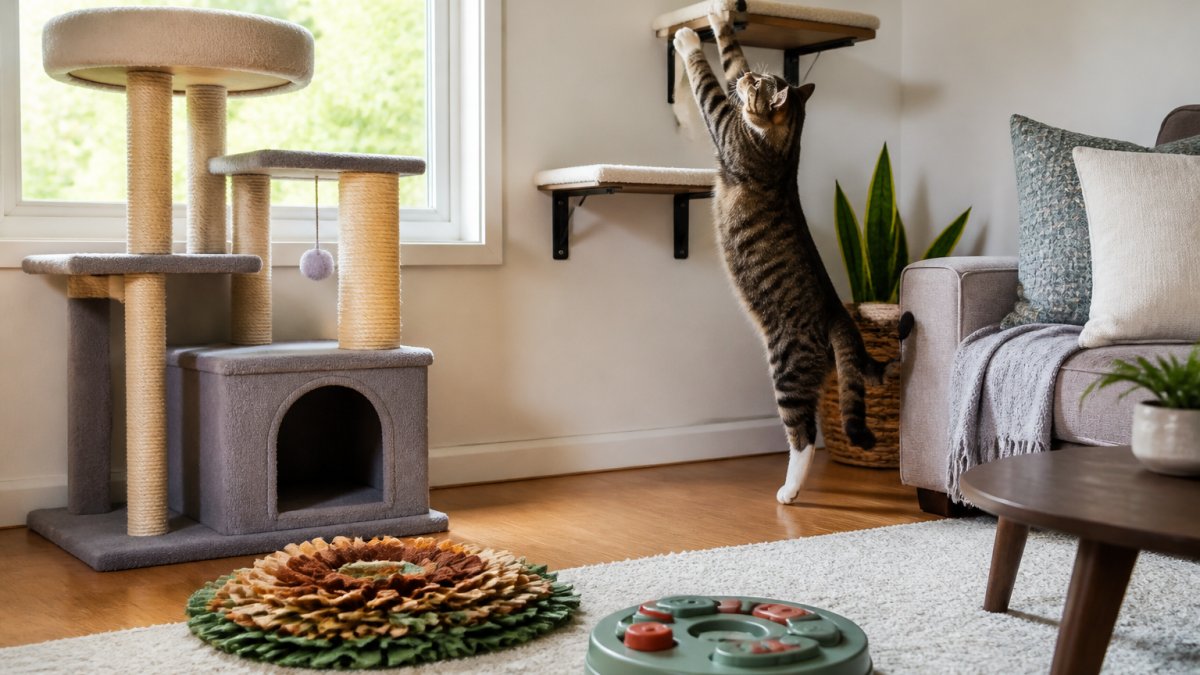
Pick a quiet corner with a window if you can. Cats want to watch the room without being stepped on. The goal is not a pile of toys in one spot.
Plan the Zones Before You Buy Anything
Think of the station as four zones that share one area:
- Vertical zone: a cat tree, wall shelves, or a window perch. This is the cat's lookout and the first thing to place.
- Hide zone: a covered bed, a box, or a cubby tucked into a corner or under a shelf. Cats need a retreat they can reach without crossing open floor.
- Food zone: puzzle feeders and a water bowl on a washable mat, set slightly apart from the litter box and away from heavy traffic.
A common pattern is to keep the food zone and the play zone on opposite sides of the station so a cat can eat without a toy rolling into the bowl. Keep the hide zone against a wall or in a corner, not in the middle of the room.
A Simple Setup Sequence
- Clear the floor space. Pick a spot away from heavy foot traffic, drafts, and appliance noise. Measure the footprint you can spare; a station can work in as little as a 3-by-3-foot corner.
- Anchor the vertical zone first. Place a cat tree or shelves near the window. Height means safety to a cat. Push the tree against a wall and, if it is tall or lightweight, secure it with a wall strap or a sturdy base.
- Set up the hide zone. A covered bed or box gives your cat a retreat. Face the opening toward the room, not the wall, so your cat can watch while hidden.
- Lay down the food zone. Put puzzle feeders on a washable mat. Keep the mat a step or two away from the hide zone so food smells do not compete with the resting spot.
- Add the play zone last. Scatter a few toys and a snuffle mat, then rotate them. Leave open floor so your cat can stalk and pounce.
- Introduce your cat slowly. Let them explore on their own terms. Do not pick the cat up and place them in the station; let curiosity do the work.
Run a Safety Check Before Your Cat Explores
Check the station before your cat does. Loose strings, small parts, and unstable shelves cause real injuries. A five-minute check prevents most problems.
- Anchor tall cat trees to the wall or a sturdy base.
- Trim loose strings and remove small detachable parts.
- Confirm collars fit safely. Our guide to lightweight cat collars walks through fit and safety.
Adjust the Layout After the First Week
Watch how your cat uses the station for a week, then move one or two things. If your cat ignores the window perch, try a different height or angle. If the food zone is messy, move the mat onto a hard floor. Small adjustments beat a full rebuild.
Cat Enrichment Toys, Puzzle Feeders, and Sensory Extras
The right cat enrichment toys turn feeding and play into brain work. Start with a puzzle feeder and one or two interactive toys, then add more as your cat masters them.
Cat Puzzle Feeders and Food Toys
Cat puzzle feeders make your cat work for kibble or treats. For a treat-dispensing puzzle toy that taps foraging instincts, try the Brain Games Treat Dispensing toy. That taps into natural foraging instincts and slows fast eating.

- The acorn-shaped feeding toy ball dispenses treats as your cat rolls it.
- A sniff and snack puzzle ball adds nose work to the mix.
For more options, browse our full collection of enrichment toys. Start with one feeder. Add a second once your cat gets the hang of it.
Pet Toys Acorn Shape Feeding Toy Ball →

Safety and Hazard Checks Before Your Cat Explores
Check the station before your cat does. Loose strings, small parts, and unstable shelves cause real injuries. A five-minute check prevents most problems.
- Anchor tall cat trees to the wall or a sturdy base.
- Trim loose strings and remove small detachable parts.
- Check toys for rips before each play session.
Watch out: never leave a snuffle mat or plush toy out unsupervised if your cat chews fabric.
Cat Toy Rotation and a Maintenance Schedule That Works
Cat toy rotation keeps the station interesting without buying more stuff. Cats get bored with the same toys. Swap a few out each week and they feel new again.
| Task | How Often | Why It Matters |
|---|---|---|
| Swap out 3-4 toys | Weekly | Keeps novelty high |
| Wash puzzle feeders | Weekly | Stops bacteria buildup |
| Check toys for damage | Every play session | Prevents choking risks |
| Vacuum the station area | Weekly | Removes hair and crumbs |
| Deep-clean beds and mats | Monthly | Keeps smells fresh |
Store unused toys out of sight. Bring them back after a week or two. Your cat will act like they're brand new.
Tailoring the Station to Your Cat and Your Space
Every cat is different, so adjust the station to fit yours. A kitten needs climbing and chase games. A senior cat needs low steps and soft resting spots. Watch how your cat uses the space, then shift things around. The table below is a starting point, not a rulebook.
Match the Station to Your Cat's Age and Mobility
- Kittens and young adults: prioritize vertical space and fast-moving play. Add a tall tree, shelves at different heights, and wand toys. Keep small parts out of reach; kittens chew and swallow more than adult cats.
- Adult cats: a balanced station with one climbing route, one hide, one feeder, and a rotating toy selection usually holds attention.
- Seniors and cats with arthritis: lower the climb. Use ramps or steps to a low perch, a heated or orthopedic bed, and feeders at floor level. A common pattern is to place the food zone within a few steps of the resting spot so an older cat does not have to cross the room.
Read Temperament and Sensory Preferences
- Shy or anxious cats: put the hide zone first and give it a clear escape route. Skip bells and crinkle toys at first; sudden sounds can startle a nervous cat.
- Bold, high-energy cats: add a second climbing route and a feeder that rolls. These cats often ignore a station that is too easy.
- Cats who prefer scent over motion: a snuffle mat, catnip or silver vine, and a feeder that hides treats do more than a moving toy.
Plan for a Multi-Cat Household
Two cats sharing one station need two of everything that matters: two hides, two feeding spots, and two climbing routes. Place them apart so one cat cannot guard both. A common pattern is to set the second hide in a different corner and the second feeder a few feet from the first. Watch for a cat who blocks a doorway or perches above the only feeder; that is a sign the station needs a second route.
Fit the Station to Your Space and Budget
Small apartments work fine with a little planning. Go vertical with wall shelves and a tall tree. Skip bulky furniture and use stackable feeders. On a tight budget, start with one puzzle feeder and a DIY cardboard box hideout. Add pieces over time. Renters can use tension-mounted shelves or freestanding trees instead of wall anchors, and a washable mat protects the floor under the food zone.
Track What Works and Change One Thing at a Time
Track what works. If your cat ignores a toy for a week, rotate it out. If they love a perch, add another nearby. Change one variable at a time so you can tell what made the difference. Signs the station is working include regular use of the perch, interest in the feeder, and relaxed resting in the hide zone. Signs it needs a change include avoidance, hiding in the open, or a cat who paces instead of settling.
Shopping for Your Cat Enrichment Station at Smitty's
Building a cat enrichment station doesn't take much space or money. It takes a plan: pick a spot, add height and hiding places, then layer in feeders and toys.
At Smitty's Pet Store, we keep pet care simple.
Ready to build your station? Start with a puzzle feeder, a cozy bed, and a window perch. Then add toys as your cat shows you what they love.
Frequently Asked Questions
What should you put in a cat enrichment station?
A good station covers the basics: a scratching post or cat tree for climbing and perching, a hiding spot like a covered bed or box, one or two cat enrichment toys, a puzzle feeder or food ball, and something to sniff such as a snuffle mat or a pinch of catnip. Add a water bowl nearby and rotate items weekly so the space stays interesting. Start with a few pieces rather than filling every corner, then watch which ones your cat uses most.
How often should you rotate cat enrichment toys?
Swap out about a third of the toys every week, and do a full rotation every two to three weeks. Put the rest away in a closed bin so they feel new when they come back out. Watch for signs a toy has lost its appeal, like your cat walking past it or ignoring it during play. A simple rotation schedule keeps novelty high without spending more money on new cat enrichment toys.
Can you set up a cat enrichment station in a small apartment?
Yes. Use vertical space instead of floor space: a wall-mounted shelf, a window perch, or a compact cat tree in a corner. A snuffle mat and a puzzle feeder take up less than a square foot each and can slide under a chair when not in use. Keep the station to one wall or one corner, and rotate items rather than displaying everything at once. Small spaces work well when the setup is intentional.
How do you make a cat enrichment station safe?
Check for loose strings, small detachable parts, and frayed fabric that a cat could swallow. Secure shelves and cat trees to the wall, keep cords and dangling blinds out of reach, and remove any plant that is not confirmed cat-safe. Supervise your cat with new toys the first few times, and put away plush or fabric toys after play if your cat tends to chew. Replace damaged toys rather than repairing them.
Your cat deserves a space that keeps them busy, calm, and healthy. Smitty's Pet Store makes it easy with a curated selection of enrichment toys, practical setup guidance, and friendly support for every pet parent. Get started with Smitty's Pet Store and give your indoor cat a station they'll explore every day.
