

Best Pet Carriers for Airline Travel Under Seat: 2026 Review

Table of Contents
- Quick Comparison: Best Pet Carriers for Airline Travel Under Seat
- What to Look for in Airline Travel Carriers (And What to Ignore)
- Airline Pet Carrier Size Requirements: What Actually Fits Under the Seat
- Tips for Flying with a Pet in Cabin: From Check-In to Landing
- How to Prepare a Dog for Air Travel: A Step-by-Step Plan
- Top Picks from Smitty's Pet Store for In-Cabin and Travel
- Common Mistakes to Avoid When Choosing an Airline Pet Carrier
- Conclusion
- Frequently Asked Questions
Last Updated: September 13, 2026
Quick Comparison: Best Pet Carriers for Airline Travel Under Seat
The best pet carriers for airline travel under seat are soft-sided, ventilated, and sized to the specific airline's underseat clearance, not to a generic "small pet" label. The most common reason a pet gets turned away at the gate isn't the pet. It's the bag.
Here's the short version before we get into the details:
| Carrier | Price | Type | Best For | Key Feature |
|---|---|---|---|---|
| Breathable Pet Carrier Bag | $111.27 | Bubble backpack | Anxious pets who need to see out | Transparent acrylic window, 12 ventilation holes |
| Pet Carrier Backpack | $47.33 | Ventilated backpack | Small to medium pets, all-day carry | 41.9 × 25.4 × 43.2 cm interior, 850g |
| Breathable Mesh Pet Carrier Backpack | $45.32 | Mesh backpack | Budget-conscious travelers | Internal leash attachment, 17 color options |
| Stylish Pet Car Carrier | $80.19 | Car seat carrier | Road trips and vet visits | Secure seat straps, cushion included |
The first three are built for hands-free carry to and through the airport. The fourth is a car carrier, and we'll explain exactly where it fits into a travel plan and where it doesn't.

What to Look for in Airline Travel Carriers (And What to Ignore)
Most guides lead with fabric quality. That's the wrong priority. The features that decide whether you board are structural, and they're boring: dimensions, ventilation, closure security, and whether the bag holds its shape when you slide it under a seat.
What actually matters:
- Underseat dimensions, measured against your specific airline's published limits, not a universal standard
- Breathable mesh panels on at least two sides, so air moves even when the bag is pressed against a seatback
- Locking zippers or a safety lock, because a determined pet can nose open a standard zip
- A safety tether or internal leash attachment, so your pet stays put if the bag shifts
- Removable padding or a washable liner, which matters more than most buyers expect
What you can ignore: decorative hardware, "airline-approved" stickers with no airline named, and anything marketed purely on style. A carrier is a piece of safety equipment that happens to look nice, not the reverse.

Soft-Sided vs. Hard-Sided: Which Wins for In-Cabin Travel?
Soft-sided carriers win for in-cabin travel, and it isn't close. Hard-sided crates rarely fit under a seat because they can't compress into an irregular space, and most airlines restrict in-cabin pets to soft-sided bags for exactly that reason. A soft-sided carrier flexes against the seat frame, then recovers its shape once you're airborne.
The trade-off is structural. Soft bags offer less crush protection in a hard stop, so if your pet is large or you're checking the carrier as cargo, a hard crate is the safer choice. For underseat use, soft-sided is the only realistic option.
Airline Pet Carrier Size Requirements: What Actually Fits Under the Seat
Airline pet carrier size requirements vary by carrier, but the functional limit is the same everywhere: the bag has to slide fully under the seat in front of you and stay there for the whole flight. Most domestic airlines publish underseat limits in the range of roughly 17 to 19 inches long, 10 to 11 inches wide, and 8 to 9 inches tall, but you should confirm the exact numbers on your airline's own pet policy page before you buy, since they change and they differ by aircraft (transportation.gov).

Two details trip people up. First, window and middle seats often have less underseat clearance than aisle seats, so book accordingly. Second, regional jets have smaller underseat spaces than mainline aircraft, and some don't allow in-cabin pets at all. Check the aircraft type, not just the airline.
How to Measure Your Pet and Test Fit at Home
Measure your pet standing, not curled up. You want length from chest to hindquarters, height from floor to the top of the head or ears, and width across the shoulders. Add about an inch in each direction for movement, then compare that against your carrier's interior dimensions, not its exterior ones.
For a real-world fit test, do this before you fly:
- Set the carrier on the floor and let your pet enter and settle on their own
- Confirm they can stand, turn around, and lie down flat inside
- Zip it closed and time how long they stay calm
- Slide the loaded carrier under a chair or low table that matches your airline's underseat height
- Check that the mesh panels aren't blocked when the bag is compressed
If your pet can't stand up and turn around inside, the carrier is too small regardless of what the label says.
Tips for Flying with a Pet in Cabin: From Check-In to Landing
Tips for flying with a pet in cabin start with booking. Reserve your pet's spot when you book your own ticket, because most airlines cap the number of in-cabin pets per flight and the limit is often as low as two to four (transportation.gov). Waiting until check-in can mean being bumped to a later flight or denied outright.
At the airport, keep your pet in the carrier through security. You'll typically carry the bag through the screening lane rather than send it down the belt, and you may be asked to hold your pet while the carrier is screened separately (tsa.gov). Have a leash ready, and expect the process to take longer than a standard security pass.
Once aboard, the carrier stays under the seat for taxi, takeoff, and landing. You can usually hold it on your lap at cruising altitude if the airline permits it, but the safest habit is to keep the bag secured and zipped. Offer water during the flight, skip food in the hour before boarding, and line the bottom with an absorbent pad.
How to Prepare a Dog for Air Travel: A Step-by-Step Plan
How to prepare a dog for air travel comes down to repetition. Start at least two to three weeks before your flight, and work through the carrier in short, positive sessions rather than one long introduction.
Step 1: Make the carrier a normal object. Leave it open in the living room with a favorite toy inside. Let your dog investigate on their own schedule.
Step 2: Feed near and inside the carrier. Move the bowl progressively closer over several days, then inside with the door open.
Step 3: Close the door for short stretches. Start with a minute, then build to fifteen or twenty. Stay in the room at first, then step out briefly.
Step 4: Practice carrying the loaded carrier. Walk around the house and outside. This is where a backpack-style carrier earns its keep, since it distributes weight across your shoulders instead of one hand.
Step 5: Simulate the airport. Take a short car ride, then a walk through a busy public space with the carrier closed. Noise and motion are the two things you can't replicate at home, so expose your dog to both.
Step 6: Do a full dress rehearsal. Pack the bag, drive to the airport area, and walk the terminal if you can. A dog that has already seen the environment is far less likely to panic on the day.
A common mistake is starting too late. Dogs that get three weeks of practice handle the flight noticeably better than dogs introduced to the carrier the night before.
Top Picks from Smitty's Pet Store for In-Cabin and Travel
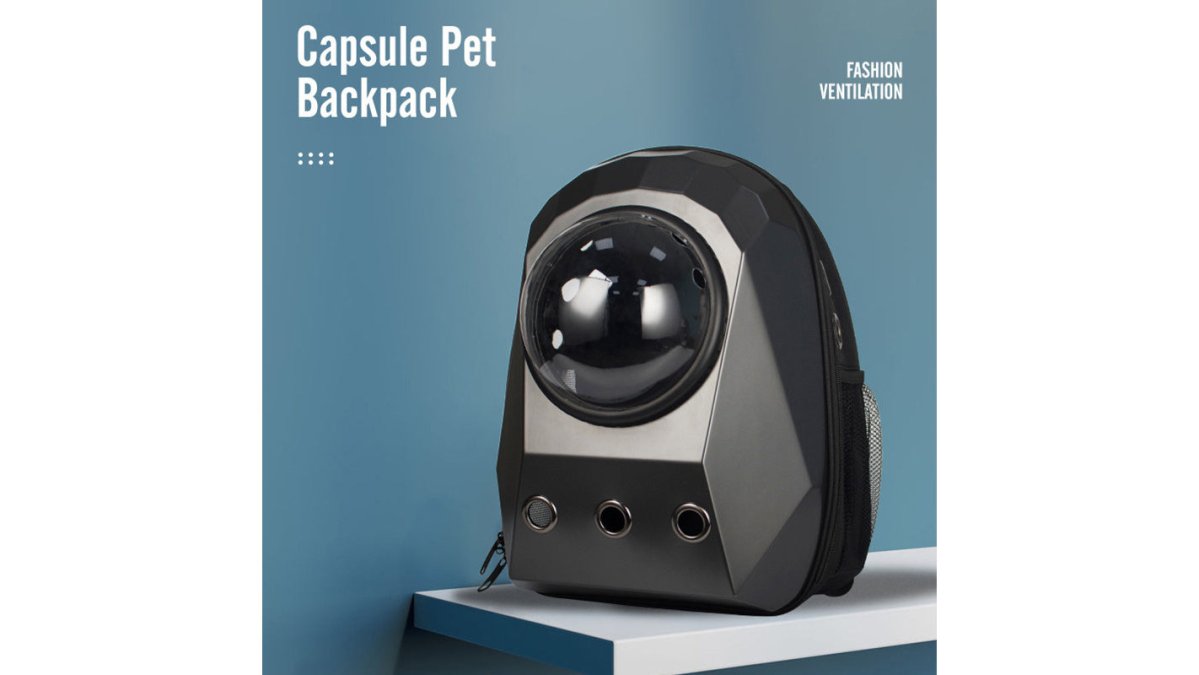
Our top pick for most travelers is the Breathable Pet Carrier Bag. At $111.27, it's the most expensive carrier we stock, and the transparent acrylic bubble window is the reason. Pets that can see out tend to settle faster, especially anxious cats and dogs who hate being in a dark enclosed space. It carries front or back, with 12 ventilation holes keeping your pet cool throughout the journey. The dimensions are 32 × 29 × 42 cm.
The one drawback: the rigid acrylic window doesn't compress the way an all-mesh bag does. If your airline's underseat space is tight, measure this one carefully before you commit.
For budget-conscious buyers, the Breathable Mesh Pet Carrier Backpack at $45.32 is the value pick. It's waterproof Oxford cloth with mesh panels, weighs just 330g, and includes an internal leash attachment that keeps your pet secured inside. The open-top, legs-out design lets your pet peek out in comfort, and it comes in 17 color and filter combinations.
The Pet Carrier Backpack at $47.33 sits between the two. It measures 41.9 × 25.4 × 43.2 cm with a roomy interior for small to medium pets, and at 850g it stays comfortable on a full travel day. Four colors, ventilated construction, secure closures.
The Stylish Pet Car Carrier at $80.19 is the outlier here. It's a car seat carrier with secure straps and an included cushion, not an underseat bag. Buy it for the drive to the airport and for vet visits, not for the cabin.
Common Mistakes to Avoid When Choosing an Airline Pet Carrier
The most expensive mistake is buying a carrier before checking your airline's policy. Buy the bag that matches your route and aircraft, then confirm the policy in writing before your travel date.
Other mistakes we see often:
- Trusting "airline-approved" marketing. No single carrier is approved by every airline. The approval is route-specific and changes by aircraft.
- Sizing to the pet, not the seat. A carrier can fit your dog perfectly and still not fit under the seat.
- Skipping the tether. An internal leash attachment is cheap insurance against a pet bolting when the bag opens at security.
- Ignoring the return trip. International flights often have stricter carrier and documentation rules than domestic ones, so build in extra margin.
- Forgetting cleanup. Line the carrier with a washable pad and wipe the interior after every flight. A carrier that smells like the last trip makes the next one harder.
Conclusion
Choosing the best pet carriers for airline travel under seat comes down to three numbers: your pet's measurements, your carrier's interior dimensions, and your airline's underseat limit. Get those right and the flight is uneventful. Get them wrong and you're rebooking at the gate.
At Smitty's Pet Store, we stock carriers built for exactly this trip. The Breathable Pet Carrier Bag gives anxious pets a window to the world, the Breathable Mesh Pet Carrier Backpack delivers lightweight ventilation at a lower price, and the Pet Carrier Backpack splits the difference with a roomier interior.
Get started with Smitty's Pet Store and travel with a carrier that fits the seat, the pet, and the trip.
Frequently Asked Questions
What are the FAA requirements for under-seat pet carriers?
The FAA does not set specific carrier dimensions. Each airline sets its own rules for in-cabin pets. Most require the carrier to fit completely under the seat in front of you and stay there for the whole flight. Soft-sided carriers are typically accepted because they can compress slightly. Check your airline's policy before booking, and confirm the carrier meets their weight and size limits.
How do I know if my pet carrier will fit under an airplane seat?
Measure the under-seat space on your specific aircraft, not just the airline's general size limit. A good rule: the carrier should be no taller than 8-9 inches when packed. Test at home by placing the carrier under a chair with similar clearance. Soft-sided carriers with flexible frames give you extra leeway. If it barely fits, size down or choose a carrier with compressible sides.
Are soft-sided or hard-sided carriers better for airline travel?
Soft-sided carriers are better for most in-cabin flights. They compress to fit tight under-seat spaces, are lighter, and often have breathable mesh panels. Hard-sided carriers offer more structure but rarely fit under seats and are usually required for cargo travel. For under-seat use, pick a soft-sided carrier with locking zippers and a safety tether. Hard-sided is only better if your airline explicitly allows it and you have plenty of space.
How can I help my pet stay calm during a flight?
Start with a carrier your pet already knows and likes. Put it out at home with treats and a favorite toy weeks before the trip. On travel day, exercise your pet before the airport to burn off energy. Keep the carrier covered with a light blanket to reduce visual stress. Talk to your vet about calming supplements or pheromone sprays. Avoid sedatives unless your vet prescribes them, as they can affect breathing at altitude.
What features should I look for in an airline-approved pet carrier?
Look for breathable mesh on at least two sides, locking zippers, a safety tether inside, and a removable washable liner. A luggage sleeve or shoulder strap helps at the airport. Expandable sections give your pet extra room once you're at the gate. Check that the carrier has no wheels or rigid frames that block under-seat fit. Finally, confirm it meets your airline's weight limit for the pet plus carrier.